Phoenix summers do not give plants much room for error.
When afternoon temperatures climb past 100 degrees, the leaves are what we notice first. They wilt. They curl. Color fades. Growth slows. A plant that looked healthy a few weeks earlier can suddenly look like it is struggling just to make it through the day.
The natural reaction is often simple:
Give it more water.
But what happens when the watering schedule stays the same — and the plant begins looking dramatically different anyway?
That is exactly what one of our AZ Soil Solutions customers recently experienced in Phoenix.
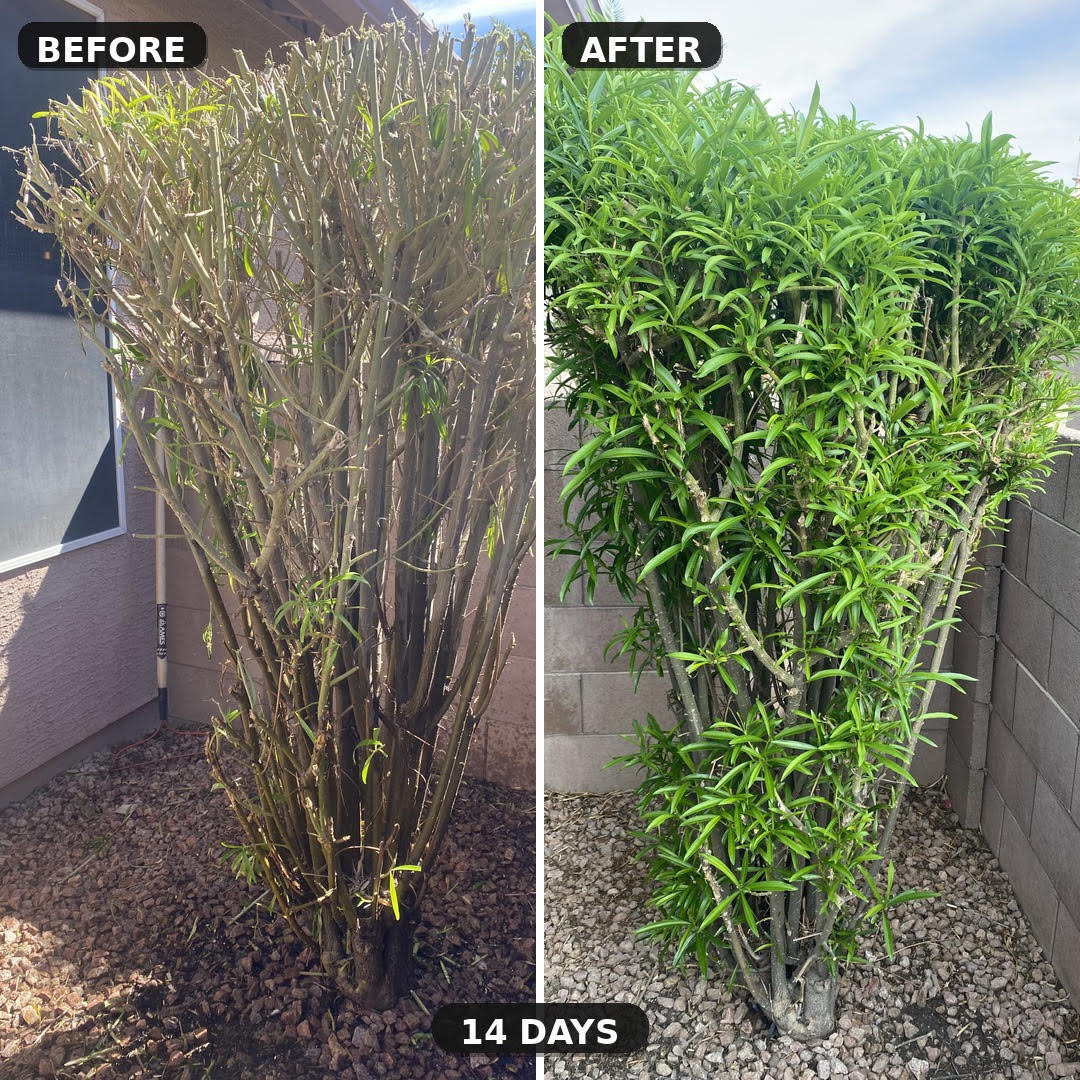
The two photos tell the story.
The first shows a plant visibly struggling. The second was taken only 14 days later.
During that period, the customer continued using the same drip-line watering schedule. Phoenix temperatures ranged from approximately 96°F to 106°F, and there was very little rain.
When we followed up and asked whether they felt AZ Soil Solutions had helped, their response was straightforward:
“Yes it did help! Additionally, it was over 96-106 degrees weather and very little rain. Thank you!”
For us, the most interesting part of this result is not simply how different the plant looks.
It is what may have been happening below the surface.
The Part of the Plant We Rarely See
When a plant is struggling, our attention naturally goes to what is above ground.
We see the leaves.
We see the stems.
We see the flowers, fruit, or lack of growth.
But the visible plant is only part of the system.
Below the soil surface is an entire root-zone environment responsible for supplying the plant with water, oxygen, minerals, nutrients, and access to biological activity.
If that environment is struggling, the plant eventually shows it.
That is why soil health is about more than simply adding fertilizer.
You can supply nutrients to a plant, but the condition of the soil around the roots still matters.
How well does the soil hold moisture?
Can water actually move into the root zone?
Is the soil compacted?
Are nutrients available where the plant can interact with them?
Is there sufficient structure around the root system?
What is happening biologically?
Those questions become especially important in a climate like Phoenix.
Growing Through 100-Degree Weather Is a Different Challenge
Arizona gardeners understand how quickly conditions can change.
A plant may look relatively comfortable in the morning and visibly stressed by late afternoon.
Extreme heat increases the demands placed on the entire plant-soil-water relationship.
The answer is not necessarily to continually increase irrigation without looking at what is happening in the soil.
Water can only benefit the plant if it reaches and remains available within the root zone.
That is one reason we spend so much time talking about soil structure and moisture management at AZ Soil Solutions.
Healthy soil is not simply wet soil.
A productive root zone needs a balance of water, air, minerals, organic compounds, biological activity, and physical structure.
The goal is to create an environment where the root system has better access to the resources already being supplied.
Why the Same Watering Schedule Matters
One detail from this Phoenix example stood out to us:
The customer kept the same drip watering schedule.
They did not tell us that they dramatically increased watering between the first and second photograph.
Instead, AZ Soil Solutions was introduced while the established irrigation schedule continued.
That does not mean a single 14-day observation proves that the soil enhancement alone caused every visible change. Gardening is far more complicated than that.
Plants respond to temperature, irrigation, sunlight, root conditions, nutrient availability, weather, plant maturity, and many other variables.
But it does make this an interesting real-world observation.
The plant improved visibly over a relatively short period while enduring temperatures reaching approximately 106°F and receiving very little rainfall.
That is exactly the type of real-world environment in which we want to understand how healthier root-zone conditions may support plants.
What AZ Soil Solutions Is Designed to Do
AZ Soil Solutions Premium Soil Enhancement is not built around the idea of simply feeding the plant with a large dose of traditional fertilizer.
Our focus is the environment around the roots.
The blend contains:
- 78 naturally occurring trace minerals
- Montmorillonite clay
- Humic and fulvic acids
- Beneficial PGPR and PGPF biology
- Bacillus subtilis
- PGPF enzyme fermentation extracts
- Wood ash
Each component plays a different role within the overall soil system.
Montmorillonite clay can interact with moisture and nutrients within the soil.
Humic and fulvic acids support nutrient interactions within the root-zone environment.
Trace minerals add mineral diversity.
Beneficial biology is included to support the living component of the soil.
Rather than looking at one isolated input, our philosophy is to look at soil as an interconnected environment.
Minerals. Water. Air. Structure. Roots. Biology.
The plant depends on all of them.
Sometimes the Problem Isn't Simply "Not Enough Water"
This is an important distinction for Arizona gardeners.
A plant showing heat stress may certainly need water.
But applying more water does not automatically fix poor soil conditions.
If the soil is compacted, water may not distribute effectively.
If the root system is limited, the plant may struggle to access available moisture.
If soil structure is poor, the balance between water and oxygen can become difficult.
And if the root-zone environment is depleted, the plant may simply have fewer resources available to support itself through stressful conditions.
This is why we encourage gardeners to think beyond the hose or drip emitter.
Ask what the water is entering.
What condition is the soil in?
That question can completely change how you approach a struggling landscape.
Arizona Makes Soil Management Especially Important
Growing in Arizona presents conditions that gardeners in many other parts of the country simply do not experience at the same intensity.
High temperatures.
Intense sunlight.
Low humidity.
Long dry periods.
Hard or compacted ground in many landscapes.
All of these factors put pressure on plants and their root systems.
That does not mean Arizona landscapes cannot thrive.
It means we have to pay closer attention to the foundation.
And that foundation is the soil.
A healthy-looking plant above ground often begins with a healthier environment below it.
What We Like About This 14-Day Result
We do not believe in pretending that one photograph is a controlled scientific study.
It isn't.
This was a customer observation under real Phoenix growing conditions.
But those observations still matter.
The customer used AZ Soil Solutions.
The irrigation schedule remained the same.
The area experienced approximately 96-106°F temperatures.
There was very little rain.
And after 14 days, the visible change in the plant was significant enough that the customer specifically told us they believed the product helped.
For a small Arizona company focused on soil health, those are exactly the kinds of results we want to continue documenting.
Not staged greenhouse conditions.
Not perfect weather.
Real yards.
Real gardens.
Real Arizona heat.
The Bigger Lesson Is Below the Surface
The most important takeaway from these photos may not actually be the plant itself.
It is the reminder that when we see a struggling plant, we should not only ask:
"What does the plant need?"
We should also ask:
"What does the soil need?"
Because the two are inseparable.
Roots cannot operate independently from the soil surrounding them.
Water cannot perform its job independently from soil structure.
Nutrients cannot help if the root-zone environment prevents the plant from accessing them effectively.
And the most beautiful part of a landscape often depends on something we never see.
The soil underneath it.
Healthy Soil. Better Growth.
At AZ Soil Solutions, that idea is at the center of everything we do.
We believe stronger landscapes, gardens, farms, flowers, vegetables, trees, and lawns start by paying attention to the environment around the root system.
This Phoenix customer gave us another great real-world example of why that matters.
Fourteen days.
The same drip watering schedule.
Temperatures reaching 106°F.
Very little rain.
And a plant that looked dramatically different.
We are excited to continue following results like these and learning alongside the gardeners, landscapers, growers, and homeowners using our product throughout Arizona and beyond.
Because what happens above the soil begins with what is happening underneath it.
Healthy Soil. Better Growth. A Solution for Every Soil.
AZ Soil Solutions — Veteran-Owned & Family-Owned