Public parks in Arizona have a harder job than most landscapes. They have to look good under heavy use, hold up through heat and monsoon swings, stay safe for people, pets, and wildlife, and do it on municipal water and maintenance budgets. When turf thins, beds fade, or irrigation demand keeps climbing, the usual response is more water, more fertilizer, and more labor. That cycle is expensive, and it rarely fixes the reason the landscape is struggling in the first place.
The soil.
Healthy park landscapes start below the surface. In arid climates, that means building living soil, soil that can hold moisture, retain nutrients, support roots, and recover from stress. For Parks and Recreation teams, that is not a luxury idea. It is a practical way to support water efficiency, environmental stewardship, and long-term appearance without constantly increasing inputs.
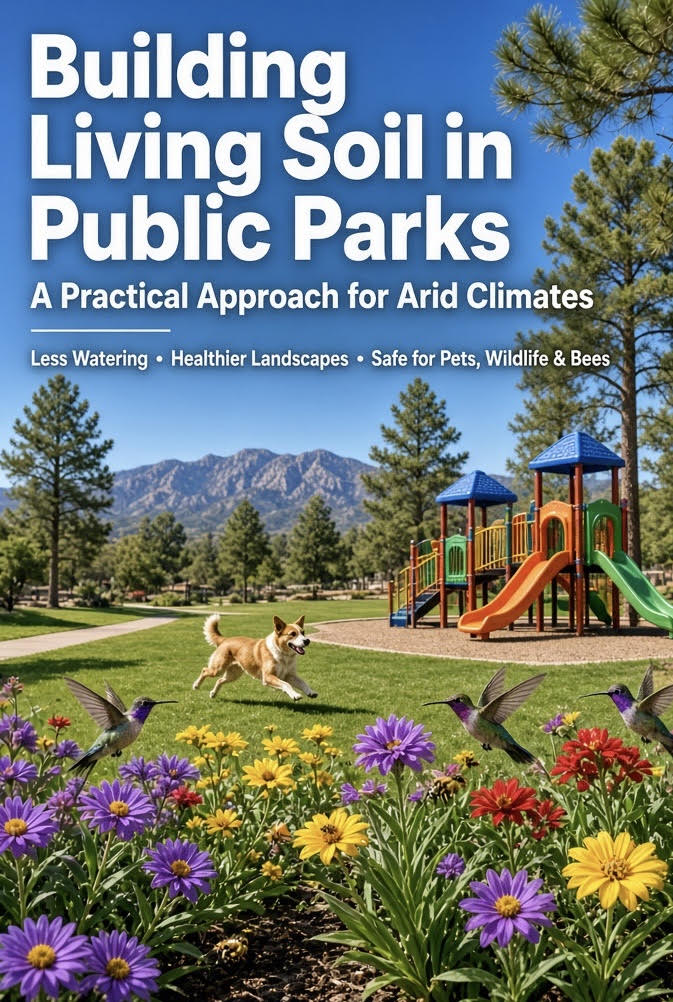
Living soil also matters because parks are not private yards. They are shared civic spaces. Children play on the lawns. Dogs walk the paths. Birds, rabbits, and other wildlife use the edges. Flowering beds and trees support bees and other pollinators. A soil program that improves plant health while remaining appropriate for public use is one of the most useful tools a department can add to its maintenance plan.
What "living soil" means in a park setting
Living soil is not just dirt with fertilizer added. It is a working system. The mineral portion holds structure and nutrients. Organic compounds help make those nutrients available. Biology supports root function and resilience. Water moves into the profile instead of running off or evaporating too quickly.
In a park, that system has to perform under conditions most backyard landscapes never face. Turf is compacted by foot traffic, events, sports, and repeated mowing. Irrigation schedules are often built around coverage maps, not around the soil's actual ability to hold water. High heat and low humidity pull moisture out of the root zone. Renovation windows are limited. The public still expects color, safety, and cleanliness. At the same time, city leadership is asking departments to use water more efficiently and manage public land with a longer view.
When the soil is weak, every one of those pressures shows up as higher cost. Crews water more. They fertilize more. They replace plants more often. The landscape may look acceptable for a few weeks and then slide backward. That pattern is familiar across arid-region parks because the soil itself is not doing enough of the work.
Why arid park soils fall behind
Northern Arizona and much of the state share a familiar soil profile: low organic matter, high pH, limited biology, and poor water-holding capacity. Some sites have caliche or compaction layers. Others are sandy enough that water and nutrients move through too fast. In both cases, plants become dependent on frequent irrigation and repeated fertilizer applications.
That creates a visible pattern in parks. Turf looks acceptable after a feeding or deep watering, then fades. Shrub and perennial beds need more frequent replacement. Water use stays high even when the landscape is not thriving. Crews spend time treating symptoms instead of improving the medium plants grow in.
A living-soil approach does not eliminate maintenance. It changes what that maintenance has to do. The goal is a root zone that holds more of the water already being applied and uses nutrients more efficiently. For a municipal department, that is the difference between a landscape that constantly needs rescue and a landscape that can carry itself farther between service visits.
A practical framework for parks
Parks do not need a complicated program. They need an approach that can be tested on a bed, a tree well, a playground border, or a high-visibility turf edge without disrupting the whole property.
A practical arid-climate framework looks like this.
First, improve the soil's ability to hold water. Montmorillonite clay helps increase moisture retention and nutrient holding in soils that otherwise dry out quickly. In park use, that matters because irrigation is one of the largest ongoing costs and one of the most visible public conservation issues. Soil that holds moisture longer gives turf and ornamental plantings a better chance to stay even between watering cycles.
Second, fill the nutritional gaps fertilizer alone does not cover. Standard N-P-K programs address only part of what plants need. Trace minerals support more complete nutrition, steadier color, and better stress tolerance. In public landscapes, that can mean fewer "surge and fade" cycles and a more consistent appearance through heat.
Third, support nutrient availability and soil function. Humic and fulvic acids help unlock nutrients already present in the soil and improve the conditions roots and microbes need to work. This is especially useful in alkaline Arizona soils, where nutrients can be present but not easily available to plants.
Fourth, rebuild biology in the root zone. Beneficial microbes, including plant-growth-promoting rhizobacteria such as Bacillus subtilis, support root function and resilience. Parks do not need a laboratory program. They need soil that can recover between stress events and help plants use water and minerals more effectively.
This is the combination behind AZ Soil Solutions Bio Mineral Soil Enhancer: 78 trace minerals, montmorillonite clay, humic and fulvic acids, and beneficial biology. It is a dry soil-blend additive designed to be incorporated or top-dressed, then watered in. That form factor matters in parks. Crews can add it during soil work that is already scheduled instead of creating an entirely new chemical program.
Where parks can start
The most useful starting points are small, measurable, and visible. New planting beds and tree installations are ideal because the soil is already open. Renovation areas already scheduled for soil work are another easy entry point. High-stress shrub beds that dry out between irrigation cycles will show moisture-holding differences more clearly than a low-stress interior lawn. Turf edges and islands that consistently fade first are also good test sites. Demonstration beds near trails, playgrounds, or civic buildings give staff and the public a chance to see the result in a real park setting.
A trial area gives a department a side-by-side comparison. Track the things parks already care about: irrigation interval, visual quality, plant replacements, and labor visits. Those are the metrics that matter in a municipal setting. A product can sound promising on paper, but parks need to see whether a bed holds up longer between waterings and whether the crew is making fewer reactive visits.
Application should stay simple. Incorporate the amendment where soil is being opened. Top-dress existing beds and water it in. Keep the first project small enough that the crew can observe it through a full heat cycle. That is how a department builds internal confidence without committing an entire park at once.
Why this supports municipal goals
Parks and Recreation departments are not just maintaining decoration. They are managing public assets under city-wide priorities. Water efficiency and environmental stewardship are two of the clearest.
Living soil supports those goals because it works on the cause, not only the appearance. Better moisture retention can help landscapes hold up longer between waterings. Improved nutrient holding can reduce the need for frequent fertilizer applications. Stronger establishment can mean fewer plant replacements. Healthier soil structure can make beds easier to maintain over time.
Those are operational benefits as much as environmental ones. A park that stays presentable with fewer inputs is easier to defend in a budget conversation and easier to align with conservation policy. It also gives staff a better story to tell the public: the department is not simply cutting water, it is improving the soil so the same water goes farther.
Pets, wildlife, and pollinators in public parks
Parks are shared ground. Children play there. Dogs walk the paths. Birds, rabbits, and other wildlife move through the edges. Flowering beds and trees also support bees and other pollinators. Any soil product used in those spaces has to fit that reality.
Bio Mineral Soil Enhancer is applied to the soil and watered in. It is not a foliar spray and is not intended to be applied to open blooms. That matters for pollinators. Once the product is incorporated or settled into the root zone, incidental contact for pets, wildlife, and bees is low compared with products meant to stay on plant surfaces.
The ingredients themselves, montmorillonite clay, humic and fulvic acids, trace minerals at amendment rates, and common beneficial soil bacteria, are generally regarded as low-risk for animals when used as a landscape soil amendment. Parks should still follow ordinary public-use practice: apply during scheduled maintenance, water it in, and return the area to normal use after dust has settled.
For bees and other pollinators, the bigger opportunity is indirect. Healthier soil supports stronger flowering plants and more consistent landscape performance with fewer harsh input cycles. That aligns with pollinator-friendly park management: keep blooms in good condition, avoid unnecessary chemical pressure, and improve the soil those plants depend on.
This product is not animal feed and should not be used that way. Used as intended in park beds, tree wells, and landscape soil, it is compatible with the need to keep public spaces safe for people, pets, wildlife, and pollinators.
What success looks like
Parks should not expect overnight transformation. Soil function improves as structure, moisture-holding, and biology begin to work together. The first useful signs are often practical rather than dramatic. Beds may not dry out as fast. Color in turf edges and plantings may stay more even. New installs may establish with less transplant stress. Crews may feel less urgency to re-feed or re-water after heat spikes.
Those early signs matter because they tell a department whether the approach is worth expanding. Living soil is a systems investment. The value shows up in resilience and reduced input pressure, not in a single green-up event. Over a season, that resilience is what helps a park stay presentable while still moving toward lower water use and more responsible land care.
A local approach for Arizona parks
AZ Soil Solutions is a veteran-owned, family-operated company focused on regenerative soil health in Arizona. Bio Mineral Soil Enhancer was developed for the soils parks, landscapers, and property managers actually work with here, not for a generic climate.
Public landscapes are one of the best places to apply that idea. Parks have to perform in the open, under real water limits, with real public use. If the soil can do more of the work, the irrigation system, the fertilizer budget, and the maintenance calendar do not have to do all of it.
For Parks and Recreation teams willing to test the approach, the next step is straightforward: choose one bed or one installation, apply the amendment as part of normal soil work, and watch how the landscape holds up through heat and watering cycles. That is how living soil stops being a concept and becomes a park practice.
If your department wants product details, application guidance, or a small trial quantity for a test area, AZ Soil Solutions is local and ready to work at a practical scale. The goal is not a complicated new program. The goal is healthier public ground, soil that holds water better, supports plants more completely, and remains appropriate for the people, pets, wildlife, and pollinators that share Arizona's parks.