When people think about Arizona, they often picture beautiful desert landscapes, towering saguaro cacti, breathtaking sunsets, and endless sunshine. While these conditions make Arizona one of the most unique places in the country, they also create some of the most challenging soils for agriculture, landscaping, gardening, and commercial cultivation.
Whether you're growing commercial crops, maintaining a landscape, cultivating cannabis, operating a nursery or greenhouse, caring for fruit trees, or simply planting vegetables in your backyard, understanding your soil is one of the most important investments you can make. Healthy plants don't happen by accident, they begin with healthy soil.
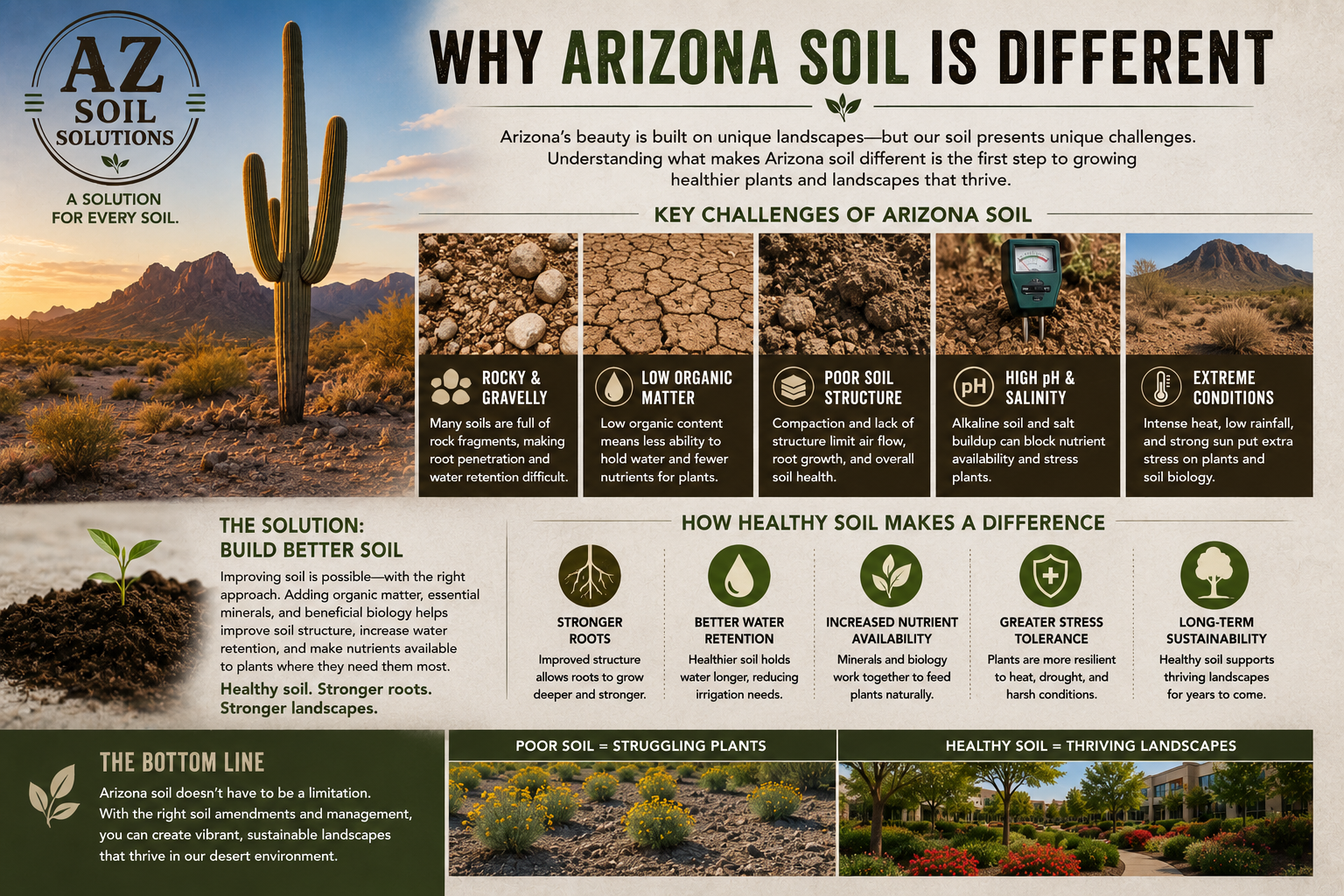
Arizona's desert environment presents unique obstacles that many growers from other parts of the country never experience. High soil pH, naturally low organic matter, hard irrigation water, salt accumulation, extreme temperatures, and dense caliche layers can all influence how plants grow and how efficiently they use water and nutrients. These conditions often leave growers wondering why their plants struggle even after regular watering and fertilization.
The good news is that these challenges are not impossible to overcome. By understanding how Arizona soils function and learning how minerals, biology, organic matter, and proper soil management work together, growers can create healthier, more productive landscapes that improve year after year.
At AZ Soil Solutions, we believe every successful harvest begins beneath the surface. Our mission is to educate growers while providing practical soil health solutions designed specifically for the unique conditions found throughout Arizona.
Arizona's desert environment
Arizona's climate is unlike much of the United States. Many regions receive less than 10 inches of rainfall annually, experience extremely high summer temperatures, and have low levels of natural organic matter. These environmental conditions have shaped Arizona soils over thousands of years.
Unlike regions that receive abundant rainfall, Arizona soils experience very little natural leaching. As water evaporates from the soil surface, salts and minerals often remain behind. Over time, this contributes to alkaline soils and can make certain nutrients less available to plants. While minerals may still be present in the soil, they are not always in forms that plants can easily absorb.
Understanding high pH soils
One of the defining characteristics of many Arizona soils is their naturally high pH. Soil pH measures how acidic or alkaline the soil is. Most plants perform best in soils with a slightly acidic to neutral pH, where nutrients are readily available.
Many Arizona soils are naturally alkaline due to the presence of calcium carbonate and other minerals. In alkaline conditions, nutrients such as iron, zinc, manganese, and phosphorus may become less available to plants even when they are present in the soil. This is one reason gardeners often see yellowing leaves, slow growth, or nutrient deficiency symptoms despite applying fertilizer.
Rather than assuming nutrients are absent, it's important to understand that nutrient availability is just as important as nutrient content.
The importance of organic matter
Another challenge facing Arizona soils is the lack of organic matter. Organic matter comes from decomposed plant material, roots, compost, and other natural materials that gradually become part of the soil.
In many parts of the country, leaves, grasses, and forest litter naturally replenish organic matter each year. Arizona's dry climate slows this natural process considerably.
Low organic matter can affect:
- Water infiltration
- Moisture retention
- Soil structure
- Microbial activity
- Nutrient cycling
- Root development
Adding quality compost and protecting existing organic matter are excellent ways to improve long-term soil health.
Hard water and salt accumulation
Many Arizona growers rely on irrigation because rainfall alone is not enough to support crops and landscapes. However, irrigation water often contains dissolved minerals and salts. As irrigation water evaporates, those salts remain behind in the soil.
Over time, salt accumulation can interfere with plant growth and make it more difficult for roots to absorb water efficiently. Good soil structure, proper irrigation management, and healthy biological activity all help soils better manage these conditions.
Caliche: Arizona's hidden barrier
Many Arizona properties contain a naturally occurring layer known as caliche. Caliche is a hardened layer of calcium carbonate that can develop beneath the soil surface. It acts almost like concrete, restricting root growth and limiting water infiltration.
When roots cannot penetrate this layer, plants often become shallow rooted and more susceptible to drought and heat stress. While caliche cannot always be completely removed, understanding its presence allows growers to make better decisions about irrigation, planting depth, and soil management.
Why soil biology matters even more in Arizona
Beneficial soil biology exists in Arizona just as it does anywhere else, but our environment can make maintaining healthy microbial populations more challenging. High temperatures, limited moisture, and low organic matter create difficult conditions for beneficial microorganisms.
These microbes play an essential role in:
- Recycling nutrients
- Supporting root development
- Breaking down organic matter
- Improving soil aggregation
- Helping plants access essential minerals
Building a healthy soil ecosystem means creating conditions where beneficial biology can thrive despite the challenges of the desert environment.
Building healthier Arizona soils
Although Arizona soils present unique challenges, they are far from impossible to improve. Healthy soil is built over time through consistent management practices that support both the physical and biological components of the soil.
Some important practices include:
- Maintaining organic matter
- Reducing unnecessary soil disturbance
- Supporting beneficial microorganisms
- Replenishing essential trace minerals
- Improving soil structure
- Managing irrigation efficiently
- Monitoring soil through regular testing
Small improvements made each season can produce significant long-term benefits.
The role of minerals
Healthy soils require far more than nitrogen, phosphorus, and potassium alone (which is synthetic NPK). Plants also depend upon dozens of trace minerals to support normal growth and development. These minerals contribute to countless biological processes occurring within both the soil and the plant.
Arizona soils often contain many of these minerals naturally, but availability can be affected by soil pH, moisture, and overall soil biology. Maintaining mineral diversity while encouraging healthy biological activity helps create an environment where plants can make better use of the nutrients already present.
Our approach at AZ Soil Solutions
At AZ Soil Solutions, we believe every soil has the potential to improve. Our Matrix of Life philosophy recognizes that healthy soil depends on the partnership between geology and biology. Minerals provide the building blocks, while beneficial biological activity helps cycle those nutrients and make them available to plants.
Our Bio Mineral formulation was developed with Arizona's growing conditions in mind. By combining 78 naturally occurring, organically chelated trace minerals, montmorillonite clay, beneficial Bacillus subtilis (PGPR, a nitrogen fixer), PGPF enzyme fermentation extracts, and carefully selected natural ingredients such as wood ash, our formulas help to rebalance soil pH for optimal growth results. We aim to support healthier soil ecosystems from the ground up.
Rather than simply feeding plants, our goal is to help build stronger, more resilient soils capable of supporting healthy growth over the long term.
Healthy soil is a long-term investment
Improving soil is not an overnight process. The healthiest agricultural soils in the world have developed through years of natural biological activity and careful stewardship.
Every step taken to improve soil structure, increase biological diversity, replenish minerals, and encourage healthy root systems contributes to future productivity. Whether you're planting a single tomato plant or managing hundreds of acres, investing in soil health is an investment in the future of your land.
Growing success starts below the surface
Arizona's desert environment is both beautiful and demanding. Its soils require a thoughtful approach that goes beyond simply applying fertilizer.
By understanding the unique characteristics of Arizona soils and working with nature rather than against it, growers can build healthier, more productive landscapes that continue to improve year after year.
At AZ Soil Solutions, we're committed to helping growers understand their soil, restore its natural potential, and build a stronger foundation for every season ahead. Because healthy soil is where every successful harvest begins.
Ready to get started? See the AZ Soil Solutions Bio Mineral or tell us about your project for a custom recommendation.