The landscaping is finished.
A new tree stands beside the driveway. Fresh shrubs line the house. Flowers fill the beds. The irrigation system is programmed, everything has been watered, and for the first few days the entire yard looks exactly the way it was supposed to.
Then something changes. A shrub begins to droop. The leaves on the new tree start curling at the edges. A flowering plant that looked beautiful at the nursery suddenly stops growing.
So you do what seems logical. You give it more water. Maybe you increase the irrigation time. Maybe you add another watering cycle. Maybe you stand there with the hose and soak the area, because surely a newly planted tree struggling in the Arizona heat must simply be thirsty.
But several days later, the plant still doesn’t look right. At that point, it is worth asking a different question.
What if the problem isn’t how much water you’re giving the plant? What if the real problem is happening below the surface?
Because when a plant leaves a nursery container and enters a landscape, it experiences one of the biggest environmental changes of its life. And the first few weeks after installation can determine how successfully that plant makes the transition.
A nursery pot is a very different world
Think about where that tree or shrub was living before you purchased it. For months, or sometimes years, its roots developed inside a container filled with carefully selected growing media. The nursery controlled many of the conditions around it. Water was delivered regularly. The growing medium was designed to drain while still retaining moisture. Nutrients were managed. The roots were contained in a relatively predictable environment.
Then the plant is purchased, transported across town and placed into a hole in the ground. Suddenly, those roots encounter an entirely different world. The surrounding soil may be dense. It may contain very little organic matter. It may drain extremely quickly, or hardly at all. It may have been compacted during construction. There may be significant differences between the nursery growing medium surrounding the original root ball and the native soil surrounding the planting hole.
Above ground, the plant still looks like the same plant. Below ground, everything has changed. And that transition matters.
The planting hole is only the beginning
One of the biggest misconceptions in landscaping is that the planting hole is the plant’s permanent home. It isn’t. The planting hole is simply where the plant starts.
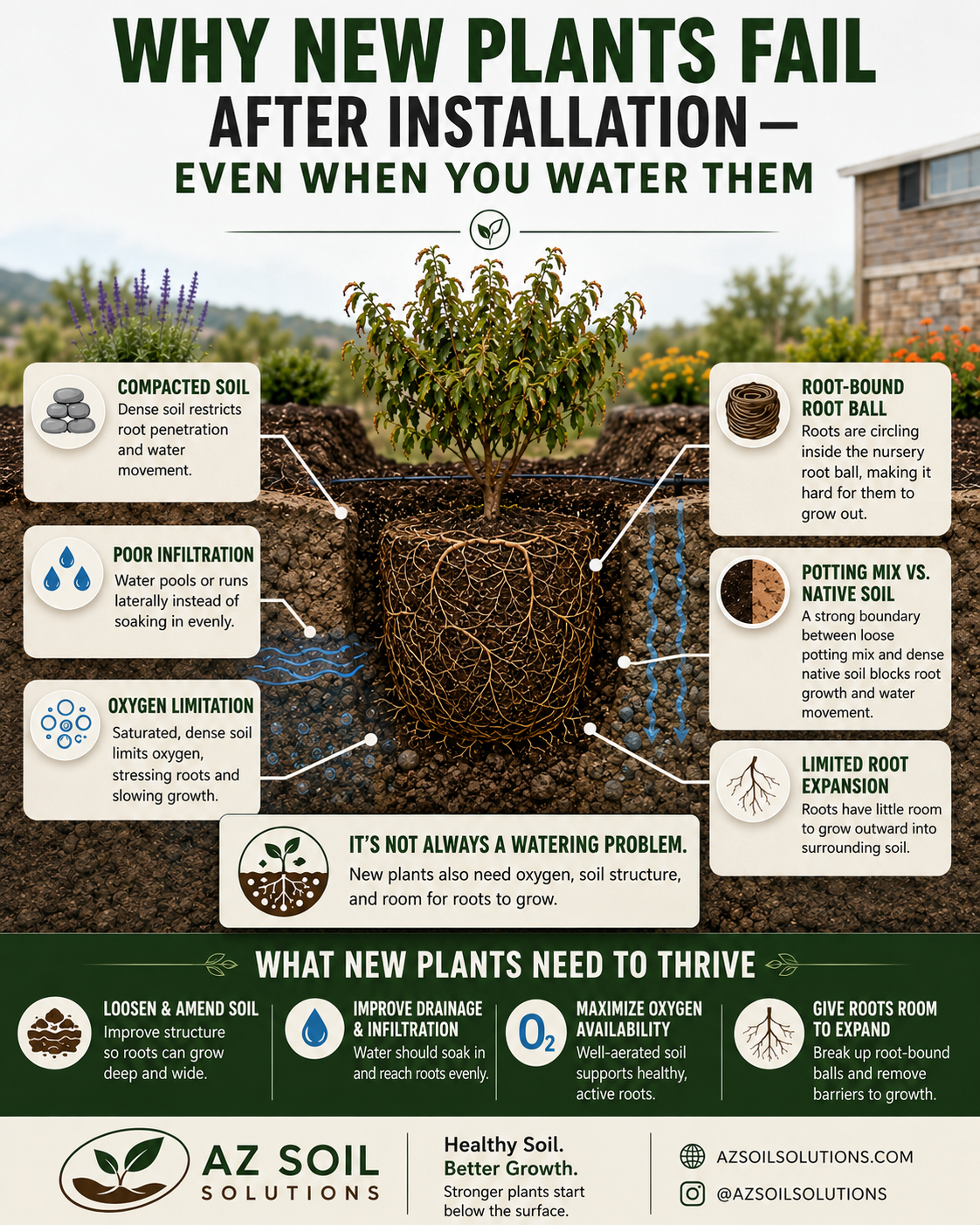
For a tree, shrub or perennial to become successfully established, new roots eventually have to move beyond the original root ball and into the surrounding soil. That means the soil outside the container-grown root system becomes extremely important. If those roots encounter a favorable environment, they can begin expanding outward. If they encounter severely compacted soil, poor drainage, unfavorable moisture conditions or a sharp transition between the original potting mix and surrounding soil, establishment can become much more difficult.
This is why preparing only a tiny planting hole while ignoring the surrounding root zone can create problems. The goal should not simply be to put the plant in the ground. The goal should be to create an environment where its roots can continue moving through the ground.
More water doesn’t always solve the problem
Water is obviously essential. A newly installed plant needs appropriate irrigation while it establishes. But water alone cannot correct every root-zone problem.
Consider compacted soil. When soil particles are pressed tightly together, the spaces between them become smaller. Those spaces matter because they influence how water and air move through the soil. If water cannot infiltrate properly, it may run across the surface instead of moving evenly into the root zone. On the other hand, poorly drained areas can remain saturated for too long.
That creates a different problem. Roots need both water and oxygen. When soil stays excessively wet, the air-filled pore spaces around roots can become limited. So a struggling plant can sometimes receive plenty of water and still have an unhealthy root environment.
This is why automatically increasing irrigation every time a plant wilts can occasionally make the situation worse. Before adding more water, it is worth understanding what the soil is actually doing with the water already being applied.
The root ball can become its own little island
There is another challenge that often occurs after planting. The growing medium inside the original nursery root ball may behave differently from the surrounding native soil. One may dry faster. One may remain wetter. Water may move through one material differently than the other. That can create a situation where the root ball and surrounding soil behave almost like two different environments.
If irrigation only wets the surrounding soil but does not adequately wet the original root ball, the plant can become stressed. If the root ball stays saturated while the surrounding soil remains dense and difficult for roots to penetrate, establishment can also suffer.
This is why checking actual soil moisture around newly installed plants can be more useful than simply assuming the irrigation timer is doing the job. What matters is not only that water was applied. What matters is where that water went.
Compaction can stop a landscape before it starts
Many landscaped properties, especially newer construction, have experienced significant soil disturbance before a single plant is installed. Heavy equipment crosses the site. Construction materials are stored on the ground. Soil is graded and moved. Then decorative rock, irrigation and plants are installed on top.
The finished landscape may look beautiful. But underneath it, the soil can be heavily compacted. Roots do not move through compacted soil as easily as they move through well-structured soil with a balance of pore spaces. Water infiltration can also be affected. And when a plant is already dealing with heat, wind, transplant stress and a completely new environment, a difficult root zone adds another challenge.
This is one reason soil preparation should happen before the landscape looks finished. Once the decorative rock is down and the plants are struggling, improving the soil becomes much more difficult.
Roots need more than water
Plants don’t grow in water alone. A healthy root zone involves an entire system: minerals, water, air, organic matter, clay particles, microorganisms, root exudates, fungi, bacteria, and countless interactions taking place around the surface of the root.
Beneficial soil microorganisms can participate in nutrient cycling and interact with plant roots. Clay and organic matter influence how nutrients and moisture behave within the soil. Humic substances can interact with nutrients and the surrounding soil environment. Roots themselves continually change the soil immediately around them.
This narrow region surrounding the roots is known as the rhizosphere. It is one of the most biologically active areas in the soil. So when we talk about helping a new plant establish, we shouldn’t only ask, “Did we water it?” We should also ask, “What kind of environment did we give its roots?”
Why soil structure matters
Healthy soil is not simply loose dirt. Structure refers to how soil particles arrange themselves and how pore spaces exist between them. Those pores influence:
- Water infiltration
- Drainage
- Air movement
- Root penetration
- Microbial habitat
- Nutrient movement
In a good root-zone environment, water can move into the soil while oxygen can still reach roots. Roots can explore the surrounding area instead of remaining confined to the original planting hole. That becomes particularly important in dry climates where every irrigation cycle matters.
The objective isn’t to make soil hold as much water as physically possible. It is to help create conditions where soil can receive, retain and release moisture appropriately while still allowing oxygen into the root zone.
The first 30 days matter
A newly installed plant has one primary job underground: establish new roots.
The leaves and branches may be what we notice, but the root system is doing much of the important work. During the first weeks after installation, the plant is adjusting to:
- Different soil
- Different moisture patterns
- Different temperatures
- Different microbial communities
- Greater exposure to wind and sun
- A much larger potential rooting area
Some temporary stress can occur during this transition. The goal is to give the plant the best possible environment to begin expanding its root system. That means installation should involve more than digging a hole, removing the container and turning on the irrigation.
Before planting, look down
Before installing a tree or shrub, take a few minutes to actually examine the soil. Is it heavily compacted? Does water infiltrate? Does the planting area drain? Is there a hard layer beneath the surface? Is the root ball badly root-bound? Will the irrigation system actually deliver water where the roots are? Are you preparing only the planting hole, or are you thinking about the larger area those roots will eventually occupy?
These questions can prevent a lot of frustration later. Because once a landscape is complete, the easiest part of the project to forget is the part no one can see. The soil.
Where AZ Soil Solutions fits
This is exactly why we developed AZ Soil Solutions around the idea of supporting the root-zone environment rather than simply feeding the plant from above. Our Premium Soil Enhancement combines 78 naturally occurring trace minerals, montmorillonite clay, humic and fulvic acids, beneficial PGPR and PGPF biology, Bacillus subtilis, and wood ash in a concentrated dry blend.
The goal is to support several parts of the soil system at once, including mineral diversity, nutrient interactions, beneficial biological activity, soil structure, moisture behavior and root-zone development. For new landscape installations, the product can be incorporated into the soil where roots are expected to develop before trees, shrubs, flowers or sod are installed.
But no soil amendment replaces good landscape practices. Plant selection still matters. Correct planting depth matters. Drainage matters. Irrigation matters. Soil testing can matter. And understanding the requirements of each plant species matters. AZ Soil Solutions is designed to complement those practices by helping landscapers and homeowners pay attention to something that is often overlooked: the soil surrounding the roots.
A beautiful landscape starts before you can see it
When a new landscape begins to struggle, it is easy to focus on what is visible. The wilted leaves. The yellowing shrub. The thinning turf. The tree that doesn’t seem to be growing. But the symptoms we see above ground often begin with conditions we cannot see below it.
So before assuming a struggling new plant simply needs another irrigation cycle, look deeper. Look at the planting hole. Look at the surrounding soil. Look at drainage. Look at compaction. Look at how moisture is actually moving. And most importantly, think about where those new roots are trying to go.
Because installing a plant is only the beginning. Establishing the root system is what turns that installation into a landscape. And healthy landscapes begin below the surface.
Healthy Soil. Better Growth. AZ Soil Solutions, a solution for every soil.