Walk into any garden center and you'll find shelves lined with fertilizers promising greener lawns, larger vegetables, brighter flowers, and explosive plant growth. For decades, homeowners, gardeners, landscapers, and farmers have been taught that if a plant isn't thriving, it simply needs more fertilizer.
It's become the default solution.
Yellow leaves? Add fertilizer.
Slow growth? Add fertilizer.
Poor harvest? Add fertilizer.
While fertilizers certainly have their place, this approach often treats the symptom instead of the cause. The real answer to healthy plants isn't always found in another bag of fertilizer. It's often found in the living world beneath your feet.
Most people spend their time admiring lush green lawns, colorful flowers, towering trees, and overflowing vegetable gardens. Very few ever stop to think about what is happening underground.
Yet everything a plant becomes is determined by what happens below the surface.
Soil Is Alive
Healthy soil isn't simply dirt.
It's one of the most biologically active ecosystems on Earth.
A single teaspoon of healthy soil can contain billions of microorganisms working around the clock to support plant life. Beneath every healthy landscape is an underground community made up of:
- Beneficial bacteria
- Mycorrhizal fungi
- Earthworms
- Protozoa
- Nematodes
- Organic matter
- Water
- Oxygen
- Minerals
- Plant roots
Together, these organisms create what scientists call the Soil Food Web, a complex network responsible for nutrient cycling, disease suppression, water retention, and healthy root development.
When this living ecosystem thrives, plants thrive.
When it declines, plants begin depending more and more on outside inputs just to survive.
The Rise of Chemical Fertilizers
Modern agriculture changed dramatically during the early 1900s with the introduction of synthetic fertilizers.
Nitrogen (N), phosphorus (P), and potassium (K), commonly known as NPK, became the foundation of crop production across the world.
These nutrients are absolutely essential for plant growth.
Nitrogen encourages leafy growth.
Phosphorus supports root development.
Potassium improves overall plant health and stress tolerance.
The problem isn't that these nutrients are bad.
The problem is believing they are the only nutrients plants need.
Imagine feeding a person only protein, carbohydrates, and fat while eliminating every vitamin and mineral.
They might survive...
...but they certainly wouldn't thrive.
Plants are no different.
Plants Need More Than Three Nutrients
Scientists have identified dozens of mineral elements required for healthy plant development.
Many people are surprised to learn plants use far more than nitrogen, phosphorus, and potassium.
Healthy soils naturally contain dozens of trace minerals that support:
- Enzyme production
- Photosynthesis
- Root growth
- Cell wall strength
- Disease resistance
- Flavor development
- Seed production
- Pollination
- Stress tolerance
Over time, repeated harvesting, erosion, construction, heavy irrigation, and continuous fertilizer use can deplete these naturally occurring minerals.
Each season removes a little more from the soil.
Very little gets replaced.
Eventually the soil becomes less biologically active, less structurally stable, and less capable of supporting healthy plant growth on its own.
The Hidden Cost of Feeding Plants Instead of Soil
Chemical fertilizers often create fast, noticeable growth.
Lawns become greener.
Plants grow taller.
Leaves become larger.
But rapid growth isn't always healthy growth.
Without rebuilding the soil itself, plants often become dependent on repeated fertilizer applications because the underground ecosystem continues to decline.
Think of it like continually adding fuel to a car with a damaged engine.
It keeps moving...
...but the underlying problem remains.
Healthy soil naturally stores nutrients, cycles minerals, retains moisture, and feeds plants over time.
Depleted soil cannot.
The Soil Food Web: Nature's Underground Workforce
One of the most fascinating discoveries in soil science is that plants don't simply absorb nutrients directly.
Instead, they work together with billions of living organisms.
Plant roots release sugars into the soil.
Beneficial bacteria feed on those sugars.
Fungi transport water and nutrients over incredible distances.
Protozoa consume bacteria and release nutrients in forms plants can absorb.
Earthworms improve soil structure while increasing organic matter.
It's a continuous cycle that has existed for millions of years.
The healthier this underground community becomes, the less plants struggle.
Learn more about this living network in our guide to the soil food web.
Soil Structure Matters More Than Most People Realize
Even if nutrients are present, compacted or poor-quality soil prevents plants from reaching them. Healthy soil should contain tiny pockets of air, water, minerals, and organic matter. Roots require oxygen just as much as they require water. When soils become compacted, roots cannot expand. Water either runs off or pools. Microbial life declines. Plants become stressed.
This is why improving soil structure is every bit as important as supplying nutrients.
Why Montmorillonite Clay Is So Valuable
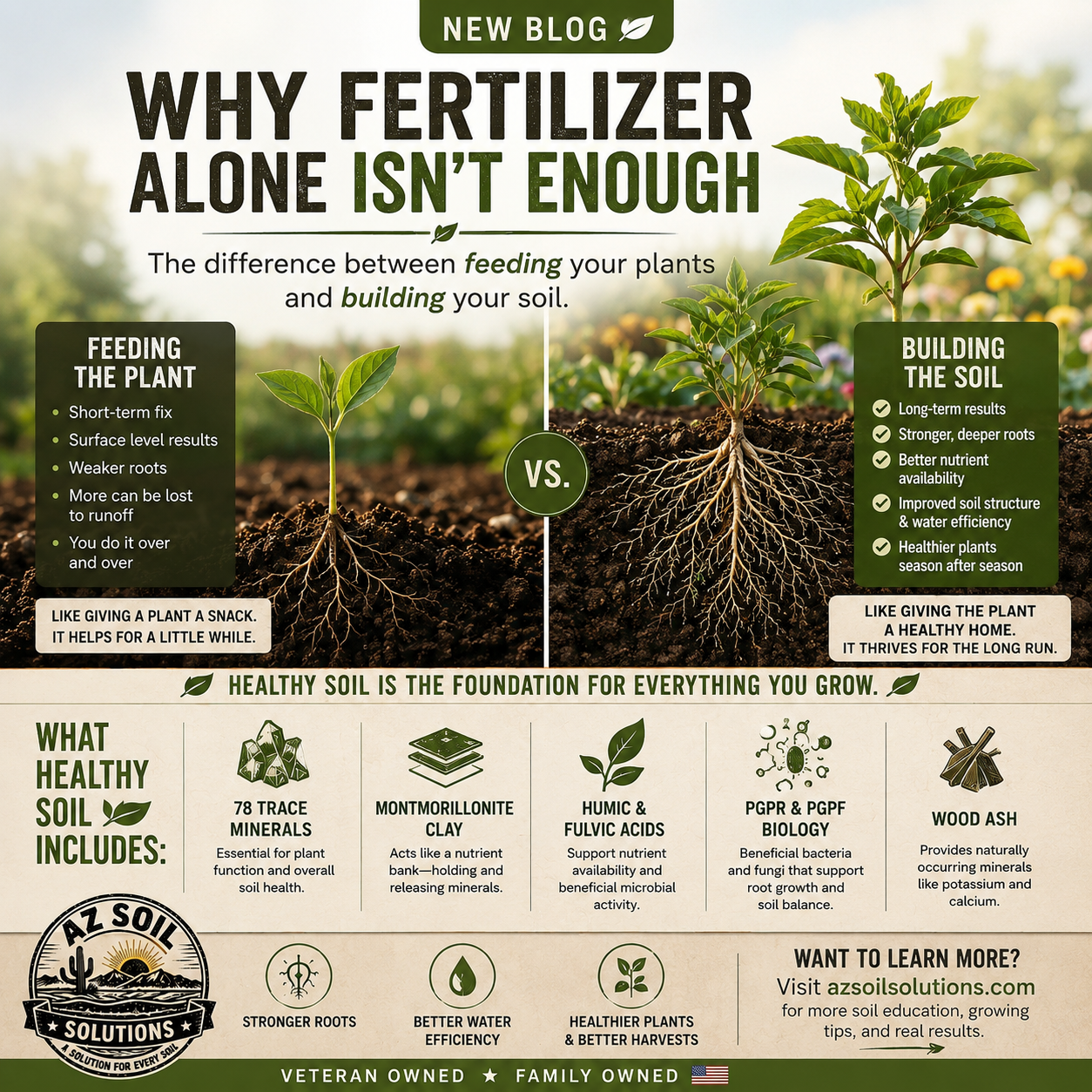
One of the unique ingredients in AZ Soil Solutions is montmorillonite clay.
This naturally occurring clay has an incredibly high cation exchange capacity (CEC), allowing it to attract and hold valuable nutrients rather than letting them wash away.
Think of it as a natural nutrient bank beneath your plants.
It stores minerals until roots and beneficial microbes need them.
Its microscopic structure also creates countless tiny spaces where beneficial bacteria and fungi can establish themselves.
Rather than simply feeding today's plant growth, it helps build tomorrow's healthier soil.
Humic and Fulvic Acids: Nature's Nutrient Transport System
Healthy soils naturally contain humic and fulvic substances formed through the decomposition of organic matter. These compounds improve nutrient availability while supporting microbial activity. Humic acids help improve soil structure, moisture retention, and microbial populations. Fulvic acids assist in transporting nutrients throughout the soil and making them more available to plants. Together, they create an environment where plants can make better use of the nutrients already present.
Beneficial Biology Makes the Difference
Healthy soil isn't built with minerals alone. It also depends on beneficial biology. AZ Soil Solutions contains beneficial Plant Growth-Promoting Rhizobacteria (PGPR), including Bacillus subtilis, along with Plant Growth-Promoting Fungi (PGPF) enzyme fermentation extracts. These naturally occurring organisms help:
- Encourage stronger root systems
- Improve nutrient uptake
- Support soil biology
- Help suppress certain harmful pathogens
- Improve overall plant vigor
Instead of replacing nature, they help restore the biological relationships healthy soils were designed to have.
Why Trace Minerals Matter
Our premium blend also contains 78 naturally occurring trace minerals. Although plants only require tiny amounts of many of these minerals, they play enormous roles in plant metabolism. Trace minerals influence:
- Plant color
- Flavor
- Fruit quality
- Root development
- Stress tolerance
- Disease resistance
- Overall plant health
Healthy soil isn't measured simply by how much nitrogen it contains. It's measured by how complete the entire ecosystem becomes.
Wood Ash: Returning Minerals to the Soil
Wood ash has been used for centuries to return valuable minerals back into depleted soils. When used responsibly and in balanced formulations, it contributes naturally occurring minerals that support long-term soil fertility. Combined with clay, humic substances, beneficial biology, and trace minerals, it becomes another piece of rebuilding healthier soil instead of simply feeding plants for a short period.
Rebuild the Foundation
Imagine building a luxury home. Would you spend all your money on beautiful walls while ignoring the foundation? Of course not.
Plants work the same way.
Everything you see above ground depends entirely on what exists below it.
Healthy roots create healthy plants.
Healthy soil creates healthy roots.
Everything starts beneath the surface.
The AZ Soil Solutions Difference
At AZ Soil Solutions, our mission isn't simply to sell another fertilizer. Our goal is to help restore the living foundation beneath every lawn, garden, landscape, farm, orchard, and flower bed. Our Premium Soil Enhancement Blend combines:
- 78 naturally occurring trace minerals
- Montmorillonite clay
- Humic and fulvic acids
- Beneficial PGPR biology
- PGPF enzyme fermentation extracts
- Wood ash
Together, these ingredients help improve soil structure, support beneficial microbial life, increase nutrient availability, encourage stronger root systems, and build healthier soil over time. Because healthier soil doesn't just produce healthier plants, it creates healthier ecosystems.
Final Thoughts
The next time a lawn begins yellowing or a garden slows down, ask yourself one simple question:
Am I feeding my plants... or am I feeding my soil?
The answer could change the way you garden forever.
Strong plants don't begin with fertilizer.
They begin with healthy roots.
Healthy roots begin with living soil.
And living soil begins with rebuilding the foundation beneath your feet.
About AZ Soil Solutions
AZ Soil Solutions is a veteran- and family-owned Arizona company dedicated to helping homeowners, gardeners, landscapers, farmers, and growers build healthier soil naturally. We believe the future of healthy plants starts underground, where living biology, balanced minerals, and healthy soil structure work together to create lasting results, not just temporary growth.
Healthy Soil. Better Growth.
AZ Soil Solutions: A Solution for Every Soil.
Ready to rebuild your soil? Explore the AZ Soil Solutions Bio Mineral or tell us about your project.