Walk through an untouched forest after a spring rain, and you'll witness one of nature's greatest miracles without even realizing it. Towering trees stretch toward the sky, wildflowers bloom beneath the canopy, and the forest floor is blanketed with leaves, branches, and fallen trees.
Yet despite centuries of growth and decay, the forest never becomes buried beneath its own debris. Every fallen leaf disappears. Every fallen branch slowly returns to the earth. Every living thing eventually becomes nourishment for something new. No one spreads fertilizer. No one tills the soil. No one removes the fallen leaves. Nature has been quietly sustaining itself for millions of years through an extraordinary living system hidden just beneath our feet.
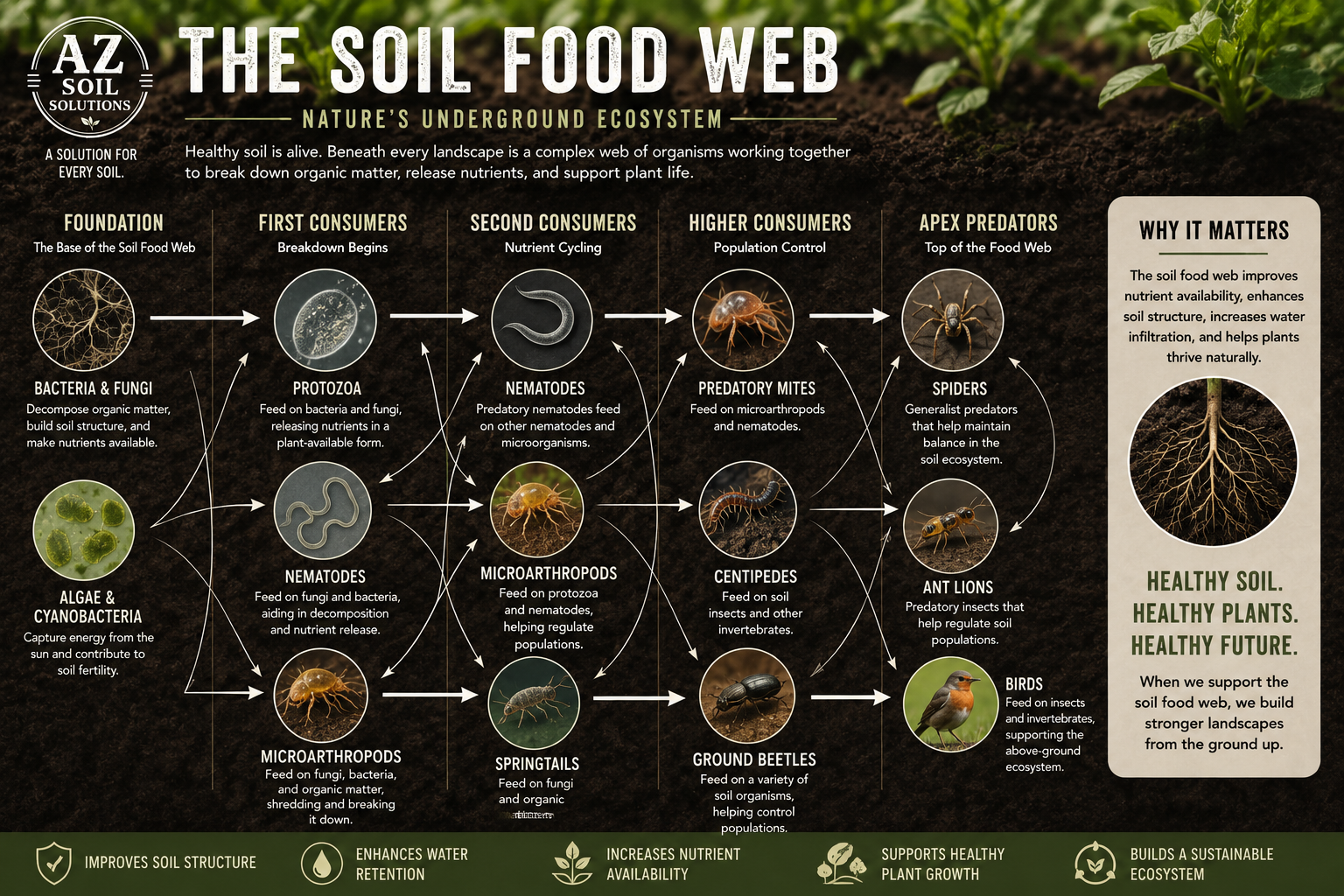
The secret isn't found in the trees. It isn't found in the rain. It isn't even found in the sunlight. The secret lies underground. Beneath every healthy landscape exists an incredible community of living organisms working together every second of every day. Scientists call this remarkable underground ecosystem the Soil Food Web. Although invisible to most people, this hidden world is responsible for building healthy soil, recycling nutrients, improving water movement, supporting root development, and sustaining nearly every plant that grows on Earth. At AZ Soil Solutions, we believe understanding the Soil Food Web changes the way we think about agriculture forever. Healthy soil isn't simply dirt. Healthy soil is alive.
A world hidden in plain sight
Pick up a handful of healthy soil. At first glance it may seem ordinary. But within that single handful lives an astonishing community of organisms. A teaspoon of healthy soil can contain billions of bacteria, miles of fungal threads, thousands of protozoa, beneficial nematodes, microscopic arthropods, and countless other organisms too small to see with the naked eye. Each has a purpose. Each performs a specific job. Each depends on the others. Together they create one of nature's most efficient recycling systems. Nothing is wasted. Everything has value. Dead plants become food. Food becomes nutrients. Nutrients become new life. The cycle repeats over and over again. This is the Soil Food Web.
Nature's underground workforce
Imagine a thriving city. Some people build roads. Others collect waste. Some transport supplies. Others grow food. Everyone has a job that keeps the city functioning. The Soil Food Web operates much the same way. Every organism has a role. Without one group, the entire system becomes less efficient.
The recyclers: bacteria
Bacteria are among the smallest organisms living in healthy soil, yet they perform some of the biggest jobs. They begin the process of breaking down plant residues and organic materials, transforming complex organic matter into simpler compounds. As they work, nutrients are gradually released back into the soil where plants can eventually use them. Without bacteria, the natural recycling process would nearly stop. They are the first workers to arrive and the last to leave.
The underground highway: fungi
Fungi may be the greatest engineers in the soil. Their microscopic threads weave through the earth like an underground transportation network. Some fungi form partnerships directly with plant roots, extending the plant's ability to explore the soil for water and nutrients. Others help stabilize soil structure by binding tiny soil particles together. These underground highways move water, minerals, and nutrients throughout the ecosystem, connecting plants in ways scientists are still discovering. Healthy fungi create healthier soil.
The nutrient managers: protozoa
Protozoa spend much of their lives feeding on bacteria. That may sound destructive, but it is actually one of the ways nutrients become available to plants. As protozoa consume bacteria, excess nutrients are released back into the surrounding soil. This continual recycling helps maintain a steady flow of nutrients within the ecosystem. Nothing goes to waste. Nature simply continues the cycle.
The population managers: beneficial nematodes
Many people hear the word “nematode” and immediately think of plant disease. In reality, countless nematodes are beneficial. They help regulate populations of bacteria, fungi, and other microscopic organisms while contributing to nutrient cycling. Like wolves helping maintain balance within Yellowstone National Park, beneficial nematodes help maintain balance within the underground ecosystem.
Nature's engineers: earthworms
Few creatures have earned a better reputation among gardeners than earthworms. As they tunnel through the soil, they naturally loosen compacted ground, improve water infiltration, increase oxygen movement, and mix organic matter throughout the root zone. Their castings are rich in nutrients and beneficial microorganisms. Charles Darwin once wrote that few animals have played such an important role in the history of the world as earthworms. He may have been right.
Plants feed the soil too
One of the greatest surprises in soil science is discovering that the relationship works both ways. Most people assume the soil feeds the plant, but plants also feed the soil. Through their roots, plants release sugars, carbohydrates, proteins, and amino acids into the surrounding soil. These compounds, called root exudates, become food for beneficial microorganisms. The microorganisms respond by helping the plant access nutrients and water. It's one of the oldest partnerships on Earth. Both benefit, and both survive together.
What happens when the web is disturbed?
Like any ecosystem, the Soil Food Web depends on balance. When biological diversity declines, the system becomes less efficient. Organic matter breaks down more slowly, nutrient cycling becomes less effective, water infiltration may decline, and root systems often struggle. Healthy soil isn't built overnight, and neither is an unhealthy one. Every growing season leaves its mark. That's why stewardship matters.
Building soil instead of simply feeding plants
For decades, agriculture has understandably focused on feeding crops with the nutrients they need to produce abundant harvests. Fertility programs centered around nitrogen, phosphorus, and potassium have helped growers around the world increase production and meet the demands of a growing population. Today, however, many growers are expanding that conversation. Rather than asking only, “How do we feed the plant?”, they're also asking, “How do we build healthier soil?” Healthy soil provides far more than nutrients. It creates an environment where roots can grow deeper, beneficial organisms can thrive, water can move more efficiently, and nutrients can cycle naturally through the ecosystem.
At AZ Soil Solutions, we believe lasting success begins by supporting the soil itself. Our philosophy, The Matrix of Life, recognizes that healthy soil is created through the partnership of geology and biology. Minerals provide the building blocks, while biology helps transform those building blocks into forms plants can use. Our Bio Mineral formulation was developed with that relationship in mind. It combines 78 naturally occurring, organically chelated trace minerals, montmorillonite clay, beneficial biological technologies including Bacillus subtilis, advanced PGPF enzyme fermentation extracts, and carefully selected natural ingredients such as wood ash. Together, these ingredients are intended to support the living ecosystem beneath the surface while helping replenish mineral diversity and encourage long-term soil health. We don't believe healthy soil comes from one ingredient or one application. We believe it is built through stewardship, education, thoughtful management, and a commitment to restoring the natural processes that have sustained ecosystems for generations.
Looking beneath the surface
The next time you walk across a farm, a garden, a golf course, or your own backyard, pause for just a moment and imagine the extraordinary world below your feet. Billions of living organisms are working together at that very moment, recycling nutrients, building soil, supporting roots, moving water, and quietly sustaining life above the surface. Most people will never see this hidden world, but every healthy harvest depends on it. Once you understand the Soil Food Web, you'll never look at soil the same way again. You'll no longer see dirt. You'll see life. And when we learn to protect that life, we create healthier plants, healthier landscapes, stronger agricultural systems, and a healthier future for everyone.
Can we rebuild the Soil Food Web?
One of the most inspiring discoveries in modern soil science is that soil has an incredible capacity to recover. While years of erosion, intensive farming, repeated tillage, drought, compaction, or poor land management can reduce biological activity, healthy soil is remarkably resilient when given the opportunity to heal.
Think of the Soil Food Web as a thriving community. Every organism from the smallest bacterium to the humble earthworm plays a unique role in keeping the ecosystem functioning. When one group begins to decline, the entire community feels the effects. Nutrient cycling slows, organic matter accumulates differently, soil structure weakens, and plants must work harder to find the water and nutrients they need.
The encouraging news is that nature wants to restore balance. When growers begin making decisions that support the living ecosystem beneath the surface, beneficial organisms gradually return. Bacteria begin recycling nutrients more efficiently. Fungi rebuild their underground networks. Earthworms improve soil structure, and plant roots become stronger as the soil around them becomes healthier.
Rebuilding the Soil Food Web is not about finding a single product or a quick fix. It is a long-term commitment to becoming a better steward of the land. Every season presents an opportunity to improve the health of the soil by encouraging biological diversity, protecting soil structure, and replenishing the minerals that support life underground.
Some of the most effective ways to support the Soil Food Web include reducing unnecessary soil disturbance, maintaining living roots whenever practical, returning organic matter to the soil, managing irrigation wisely, and protecting the soil surface with mulch or cover crops. Even small improvements, when practiced consistently over time, can make a remarkable difference in the health and resilience of the soil.
The soil steward's takeaway
Healthy soil is one of the few resources on Earth that can become more valuable with time when it is cared for properly. Every handful of living soil contains an extraordinary community of minerals, microorganisms, roots, fungi, insects, water, and organic matter all working together to support life above the surface. As stewards of the land, our responsibility isn't simply to grow healthier plants, but to protect and restore the living ecosystem that makes those plants possible.
When we care for the soil, we aren't just investing in the next harvest, we're investing in future generations.
Ready to get started? See the AZ Soil Solutions Bio Mineral or tell us about your project for a custom recommendation.