The irrigation is running.
From a distance, everything looks right. Water is moving across the field, the soil is darkening, and the crop is getting what it needs.
Or at least that's what it looks like.
But applied water and available water are not always the same thing.
Some water runs off before it ever enters the root zone. Some evaporates from bare soil. Some follows cracks and channels deep below active roots. In compacted ground, water may sit near the surface or move unevenly through the field. And in soil with poor structure, a surprising amount of irrigation may never become truly useful to the crop.
In dry farming regions, that difference matters.
Water is one of the most valuable resources a farmer manages. Every gallon pumped, delivered, stored, or applied carries a cost.
That means water efficiency isn't only an irrigation problem.
It is also a soil problem.
And in many cases, the ability of a crop to make better use of water begins long before the irrigation system turns on.
It begins beneath the surface.
Water has to enter the soil before roots can use it
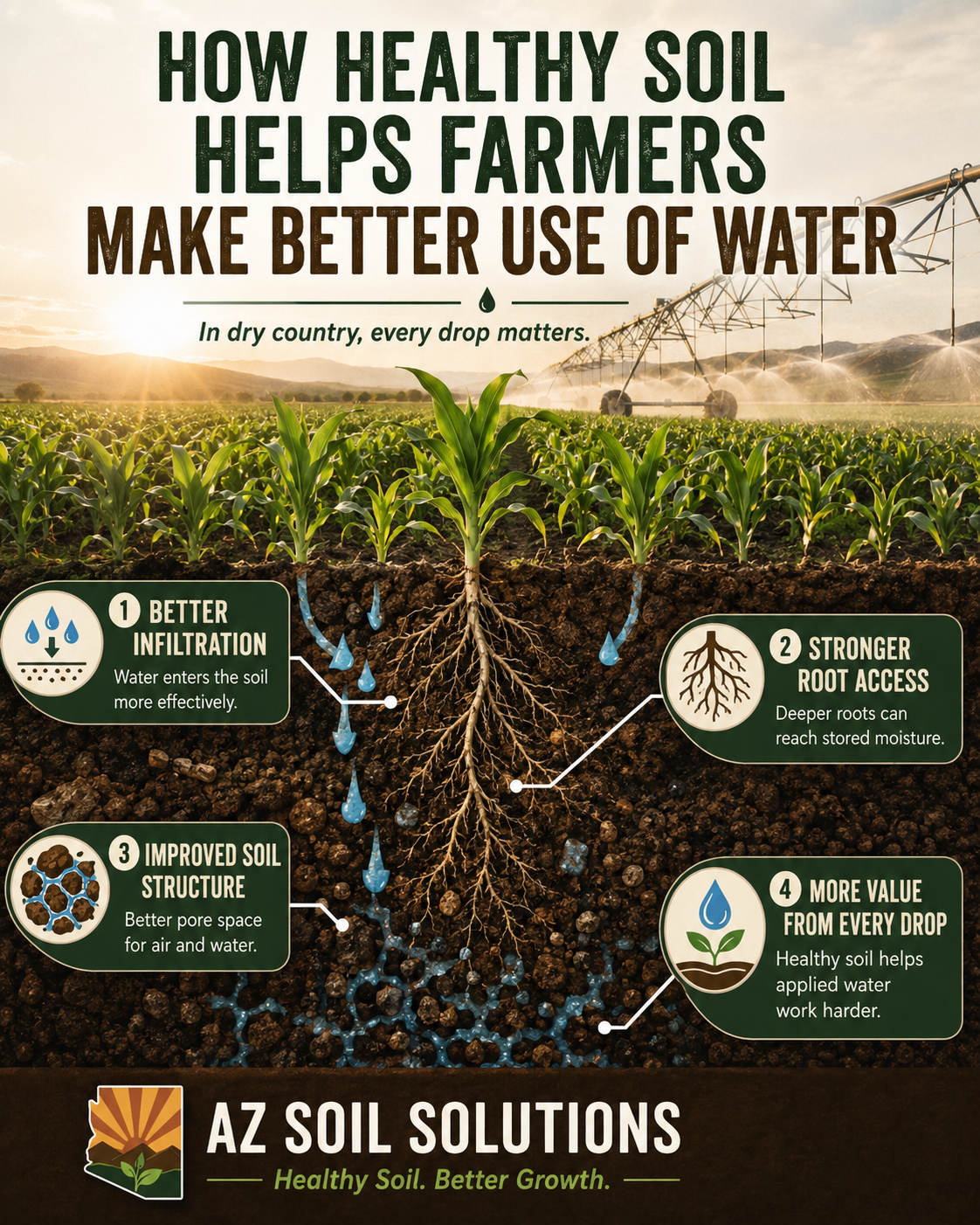
The first challenge is infiltration.
Healthy soil contains pore spaces of different sizes. These spaces allow water to move into the profile while still leaving room for oxygen.
When soil becomes compacted, crusted, or structurally degraded, those pathways can shrink or disappear.
Instead of soaking evenly into the root zone, water may begin moving sideways across the surface.
That runoff doesn't just represent lost water.
It can also carry soil particles and nutrients away with it.
A field may receive the same amount of irrigation as it did years ago, but if its structure has changed, the crop may not be receiving the same benefit.
This is why healthy soil structure is so important.
Before water can feed a crop, the soil has to accept it.
Compaction quietly changes everything
Compaction is one of the most common challenges in agricultural soils.
Heavy equipment, repeated passes over the same ground, livestock traffic, working soil when it is too wet, and natural settling can all contribute.
The effects are easy to underestimate because compaction usually happens underground.
But roots notice.
Compacted soil can restrict root penetration, reduce pore space, and alter how both air and water move through the profile.
A shallow root system has access to a much smaller reservoir of moisture than a deep one.
That becomes especially important between irrigation cycles or during extreme heat.
A crop with roots concentrated near the surface is more vulnerable to rapid drying.
A crop with a deeper, more extensive root system has the opportunity to explore a larger volume of soil for both water and nutrients.
So when farmers think about conserving water, root depth should be part of the conversation.
Better root access can mean better access to stored moisture.
Soil is a reservoir
A useful way to think about soil is as a water reservoir. But not every reservoir holds the same amount. Soil texture, organic matter, aggregation, pore size, clay content, root activity, and overall structure all influence how water behaves.
Sandy soils may allow water to move quickly through the profile. Heavy clay soils may hold substantial moisture but can become difficult for roots if they are poorly structured or compacted.
The goal isn't simply to "hold more water."
The goal is to create an environment where water is:
- able to enter the soil,
- stored within reach of roots,
- not trapped in prolonged saturation,
- and available to plants when they need it.
That balance is what healthy soil helps provide.
Why organic matter matters
Organic matter is one of the most valuable components of productive soil.
It can help improve aggregation, increase water-holding capacity, support biological activity, and create a more resilient root-zone environment.
As organic materials decompose, they become part of a larger cycle involving microorganisms, roots, minerals, and nutrients.
That cycle helps soil function more like a living system and less like an inert growing medium.
But organic matter is not permanent.
It breaks down over time.
Every harvest removes biomass from the field. In hot climates, decomposition can happen rapidly. Intensive production systems continually draw from the soil.
That is one reason building soil has to be an ongoing process.
It isn't something farmers do once.
It is part of long-term land management.
Clay can play an important role
Clay particles are extremely small, but their influence on soil can be enormous.
Certain clays have a high surface area and the ability to hold water and exchangeable nutrients.
Montmorillonite clay, for example, is known for its high cation exchange capacity.
In practical terms, that means it can help hold positively charged nutrients within the soil environment rather than allowing them to move away as easily.
Clay can also influence moisture behavior.
Used as part of a balanced soil-management system, clay minerals can help create a more stable environment around roots.
This is one reason mineral composition matters when we talk about water efficiency.
Water, nutrients, roots, and soil particles do not function independently.
They interact constantly.
Water and nutrients travel together
Plants need water for far more than hydration.
Water acts as a transport system.
Nutrients move through soil solution toward roots. Plants use water to transport dissolved minerals internally. Photosynthesis, growth, cooling, and metabolism all depend on it.
That means poor water movement can also become a nutrient problem.
If roots cannot access moisture, nutrient uptake can suffer.
And if the root system is shallow or damaged, simply adding more fertilizer may not solve the issue.
The nutrients may be present.
The plant simply may not be able to access them efficiently.
This is why healthy soil management looks at the entire root environment rather than separating irrigation from fertility.
Biology is part of the water story
Soil biology is often discussed in terms of nutrient cycling, but beneficial microorganisms are also part of the broader soil structure story.
Bacteria and fungi interact with roots and organic materials throughout the soil profile.
Fungal networks can extend through the soil beyond the immediate root surface.
Microbial activity contributes to the formation and stabilization of soil aggregates.
Those aggregates influence pore space.
Pore space influences water movement.
Once again, everything connects.
This is the pattern farmers see repeatedly when they begin thinking in terms of soil systems:
Biology affects structure.
Structure affects water.
Water affects roots.
Roots affect nutrient uptake.
Nutrient uptake affects crop performance.
That is why soil health is so difficult to reduce to one input.
Better soil does not mean "never irrigate"
Healthy soil isn't a substitute for proper irrigation.
It won't eliminate drought.
It won't make a crop independent of water.
And no soil amendment should be marketed as though it can magically replace irrigation.
What healthy soil can do is help create conditions where applied water has a better chance of being useful.
That may mean improved infiltration.
- Better root-zone storage.
- Deeper roots.
- Less runoff.
- More even moisture distribution.
- And better interaction between water, nutrients, biology, and roots.
For farmers working in water-limited environments, that is an important distinction.
The goal is not simply using less water.
The goal is getting more value from the water you already apply.
Look at the field differently
The next time irrigation is running, don't only watch the water.
Watch the soil.
Where does runoff begin?
Does water pond in certain areas?
How quickly does it infiltrate?
How deep is the moisture moving?
What does the soil look like six inches below the surface?
Twelve inches?
How deep are the active roots?
Are there compacted layers?
Do plants wilt rapidly between irrigation cycles?
Are some areas of the field performing significantly better than others under the same irrigation schedule?
These questions can reveal problems an irrigation timer cannot.
Soil testing gives you a starting point
A soil test is one of the most useful tools available to growers.
Depending on the analysis, it can provide information about pH, salinity, nutrient status, organic matter, texture, and other important characteristics.
In arid regions, salinity can be particularly important.
Irrigation water contains dissolved minerals, and as water evaporates or is used by plants, salts may remain behind.
Over time, poor drainage or insufficient leaching can allow them to accumulate.
So before adding more fertilizer or amendments, it is useful to understand what is already present.
Good soil management is not about adding everything.
It is about adding what the system actually needs.
Where AZ Soil Solutions fits
At AZ Soil Solutions, our approach has always focused on the environment beneath the plant.
Our Premium Soil Enhancement combines several components intended to support that environment:
- 78 naturally occurring trace minerals
- Montmorillonite clay
- Humic and fulvic acids
- Beneficial PGPR biology
- PGPF enzyme fermentation extracts
- Wood ash
Rather than focusing only on immediate plant feeding, the blend is designed to complement broader soil-management practices by supporting mineral diversity, nutrient interactions, biological activity, root development, and soil structure.
Montmorillonite clay contributes nutrient-holding characteristics.
Humic and fulvic substances support nutrient interactions and the soil environment.
Trace minerals broaden the mineral profile.
Beneficial biological components help support the living processes around plant roots.
And wood ash contributes additional naturally occurring mineral components.
No product replaces irrigation management, organic matter, crop rotation, soil testing, drainage, or sound farming practices.
But when these pieces are managed together, the soil has a better opportunity to function as a complete system.
Water efficiency starts underground
The most expensive irrigation system in the world cannot fix poor soil structure by itself.
The best fertilizer cannot force shallow roots to explore compacted ground.
And applying more water cannot guarantee that moisture will remain where crops can use it.
Water efficiency begins with infrastructure.
But it also begins with soil.
A well-managed root zone gives water somewhere useful to go.
It gives roots room to follow it.
It creates space for oxygen.
It helps nutrients move.
It supports biological activity.
And it gives the crop a larger underground environment to draw from when conditions become difficult.
For farmers in dry regions, that foundation matters.
Because every irrigation carries a cost.
Every drop has value.
And every crop ultimately depends on what happens after that water reaches the ground.
So the next time you watch water move across a field, remember:
The irrigation system delivers the water.
The soil determines what happens next.
In dry country, every drop matters.
Ready to build soil that makes every drop count? See the AZ Soil Solutions Bio Mineral or tell us about your project for a custom recommendation.