The reality of Arizona landscapes
Most landscapers already know the cycle. New plantings look strong for the first season. Color holds for a while after a fertilizer application. Then growth slows, leaves pale, and the same beds require another round of product and another round of labor. Clients notice the expense. Crews feel the pressure to keep properties looking good while controlling inputs. Water bills rise. Plant replacements become routine on high-stress sites.
The underlying issue is rarely a simple nitrogen shortage. Arizona soils are often depleted of a broad range of secondary and micronutrients. Structure is poor. Beneficial biology is limited. Humic substances that help hold nutrients and improve tilth are scarce. Synthetic N-P-K products address only a narrow slice of what plants need and do little to rebuild the soil itself. Over time the soil becomes more dependent on constant external inputs.
Bio Mineral Soil Enhancer was developed to interrupt that cycle. It combines 78 trace minerals, montmorillonite clay, humic and fulvic acids, and beneficial biology including plant-growth-promoting rhizobacteria such as Bacillus subtilis. The goal is not a short-term green-up. The goal is measurable improvement in soil function that supports healthier plants with fewer ongoing interventions.
How landscapers are using it
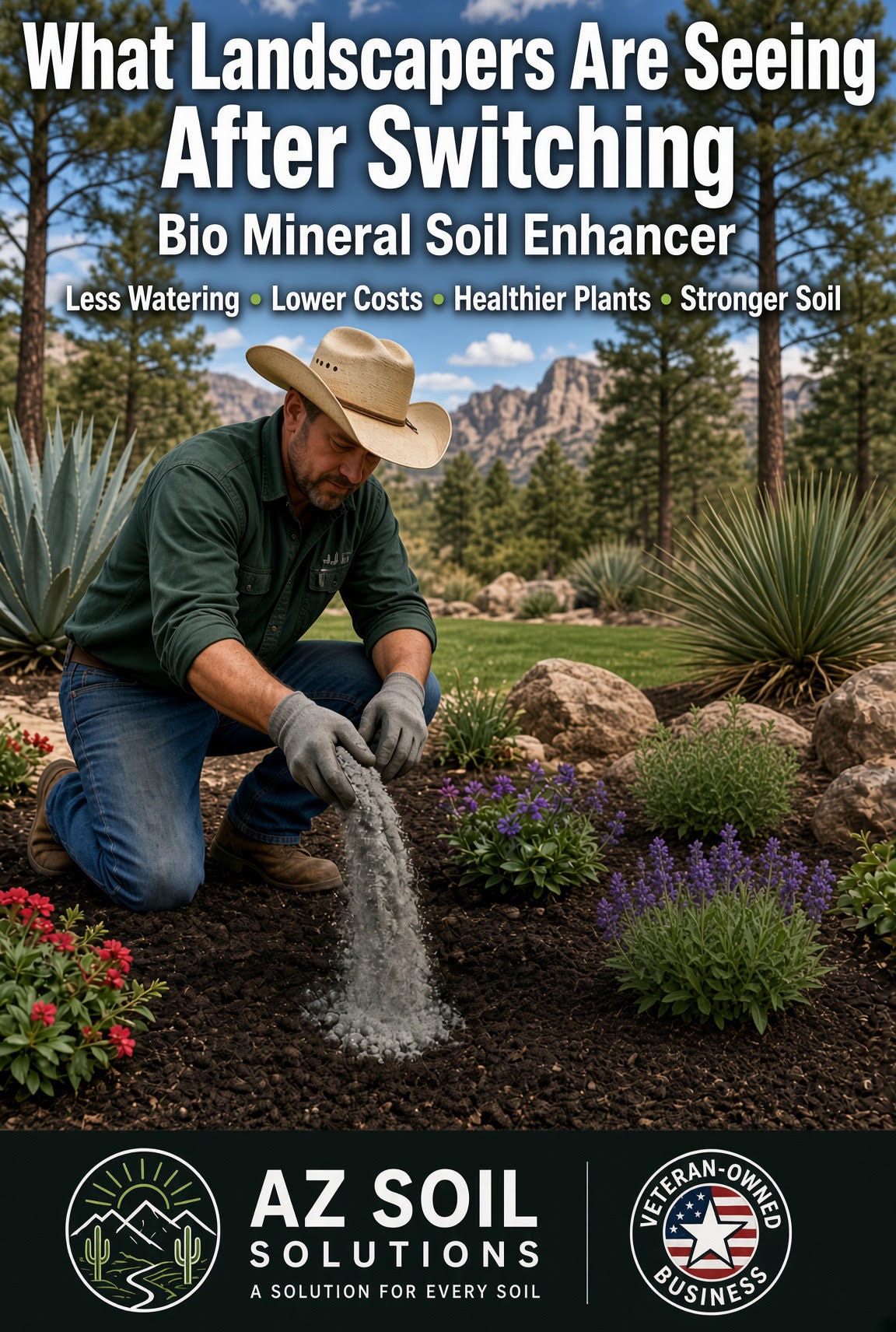
Crews who have begun using the product typically introduce it in one of three ways:
- Incorporated into the backfill or planting mix on new installs
- Top-dressed and lightly worked into existing beds and tree wells
- Blended into soil for renovations or when replacing failed plant material
Application rates are adjusted for project type and soil conditions, but the product is designed to be straightforward to handle and apply with standard equipment. Many crews start with a single high-visibility bed or a new project so they can compare results side-by-side with their conventional program.
What crews are observing
Early feedback from landscapers who have incorporated the enhancer centers on several consistent themes.
Improved soil workability and structure.
Soils that previously felt tight and resistant become easier to dig and cultivate. Compaction is reduced. Water infiltrates more readily instead of running off or pooling. This change is especially noticeable on sites with heavy clay or caliche influence.
Better moisture retention.
Plants hold up longer between irrigation cycles. Crews report that beds and tree wells stay more evenly moist and that stress symptoms appear later during heat waves. In a region where water is both expensive and increasingly regulated, this is one of the most practical benefits.
Stronger root systems on new plantings.
New trees, shrubs, and perennials establish more reliably. Root development is more vigorous, which translates into better drought tolerance and reduced transplant shock. Fewer plants fail in the first critical months.
More consistent color and growth.
Instead of the familiar pattern of rapid flush followed by fade, plants maintain steadier color and growth rates. The “surge and crash” effect common with high-nitrogen synthetic programs is less pronounced.
Reduced reliance on frequent fertilizer applications.
Once the soil begins to function better, crews find they can stretch the intervals between supplemental feeding. Some are already adjusting their maintenance calendars and reducing the number of fertilizer runs per season.
These observations are still early. Soil biology and structure improve over multiple seasons, not overnight. The landscapers seeing the clearest results are those who treat the product as a soil-building tool rather than a direct fertilizer replacement and who give the system time to respond.
The cost impact
The financial side is where many crews become most interested. Landscape companies operate on tight margins. Labor, water, plant material, and chemical inputs are the largest cost centers. Anything that reduces frequency of visits, lowers water use, or cuts plant replacement rates improves profitability.
Landscapers using the mineral-and-biology approach are beginning to see cost benefits in several areas:
Lower fertilizer volume and application frequency.
When soil chemistry and biology support better nutrient availability, less product is required to maintain appearance. Fewer applications mean less labor time, less equipment wear, and lower material cost over the course of a season.
Reduced irrigation demand.
Improved soil structure and organic matter contributions help hold moisture in the root zone. On larger commercial or multi-family properties, even modest reductions in water use add up quickly. On residential accounts, clients notice lower water bills, which strengthens retention and referrals.
Fewer plant replacements.
Stronger establishment and greater stress tolerance mean fewer dead or declining plants that must be pulled and replaced under warranty or service agreements. Replacement costs include both material and labor. Reducing that percentage has a direct effect on project margins.
Labor efficiency.
Healthier soil is easier to work. Beds that require less frequent intervention free crew time for higher-value work or additional accounts. Over a full season the cumulative labor savings become significant.
Client retention and higher-value work.
Properties that look consistently better with less visible maintenance create stronger client relationships. Landscapers report that clients respond positively when they can explain that the program is building soil health rather than simply feeding plants for short-term color. This opens the door to longer-term contracts and soil-focused renovation work.
Exact dollar savings vary by property size, plant palette, and previous maintenance intensity. The pattern, however, is consistent: lower input frequency, lower water use, and lower failure rates produce measurable cost reductions while improving the quality of the finished landscape.
Why the results align with the product design
The observations make sense when you look at what the product actually supplies.
Trace minerals address deficiencies that standard N-P-K fertilizers ignore. Many Arizona soils are low in a range of micronutrients that influence chlorophyll production, enzyme function, and stress response. Supplying a broad spectrum supports more complete nutrition.
Humic and fulvic acids improve nutrient holding capacity and availability. They also contribute to better soil aggregation, which directly affects tilth and water movement.
Montmorillonite clay adds structure and cation exchange capacity in soils that are often coarse or depleted.
Beneficial biology, including Bacillus subtilis and related plant-growth-promoting rhizobacteria, supports root function, helps plants access nutrients, and contributes to resilience under heat and drought stress.
None of these components acts in isolation. Together they begin to shift the soil from a passive medium that requires constant external feeding toward a more functional biological system. That shift is what landscapers are starting to see in the field.
Practical recommendations for crews considering the switch
Start small and measurable. Choose one or two beds or a new install where you can track performance against a conventional control. Note irrigation intervals, visual quality, and any plant losses over the first season.
Apply at the recommended rates and incorporate where possible. Surface applications still provide benefit, but contact with the root zone accelerates results.
Give the system time. Biological and structural improvements compound. The second and third seasons typically show clearer advantages than the first.
Communicate the approach to clients. Many property owners and managers respond well to a soil-health narrative, especially when it is paired with lower long-term input costs and stronger plant performance.
Track the numbers that matter to your business: fertilizer volume, number of application visits, water use where metered, and plant replacement rates. Those metrics will tell the real story.
Moving forward
Arizona landscapes will always face demanding conditions. The question is whether the response remains a cycle of higher inputs and higher costs or whether soil function can be improved enough to change the economics. Early results from landscapers using Bio Mineral Soil Enhancer suggest the second path is realistic.
Ready to try it on a property? See the AZ Soil Solutions Bio Mineral or tell us about your sites for a custom rate recommendation.