The Difference Between Feeding Your Plants and Building Your Soil
Imagine eating just one meal today and expecting it to sustain your health for the entire year. It sounds absurd—because your body needs a steady supply of water, proteins, healthy fats, vitamins, minerals, and more, all working together over time.
Yet when it comes to plants, we often take the opposite approach. Yellowing lawn? Add fertilizer. Disappointing vegetable harvest? Add fertilizer. Flowers not blooming? Add more fertilizer. Slow-growing trees? Fertilize again.
For decades, homeowners and growers have been trained to focus almost exclusively on what the plant needs right now. Fertilizers do supply key nutrients, but feeding a plant and building healthy soil are two very different things.
At AZ Soil Solutions, we believe the most powerful shift in how we grow is surprisingly simple:
Stop looking only at the plant and start looking beneath it.
The real foundation of lasting growth isn't above ground—it's under our feet.
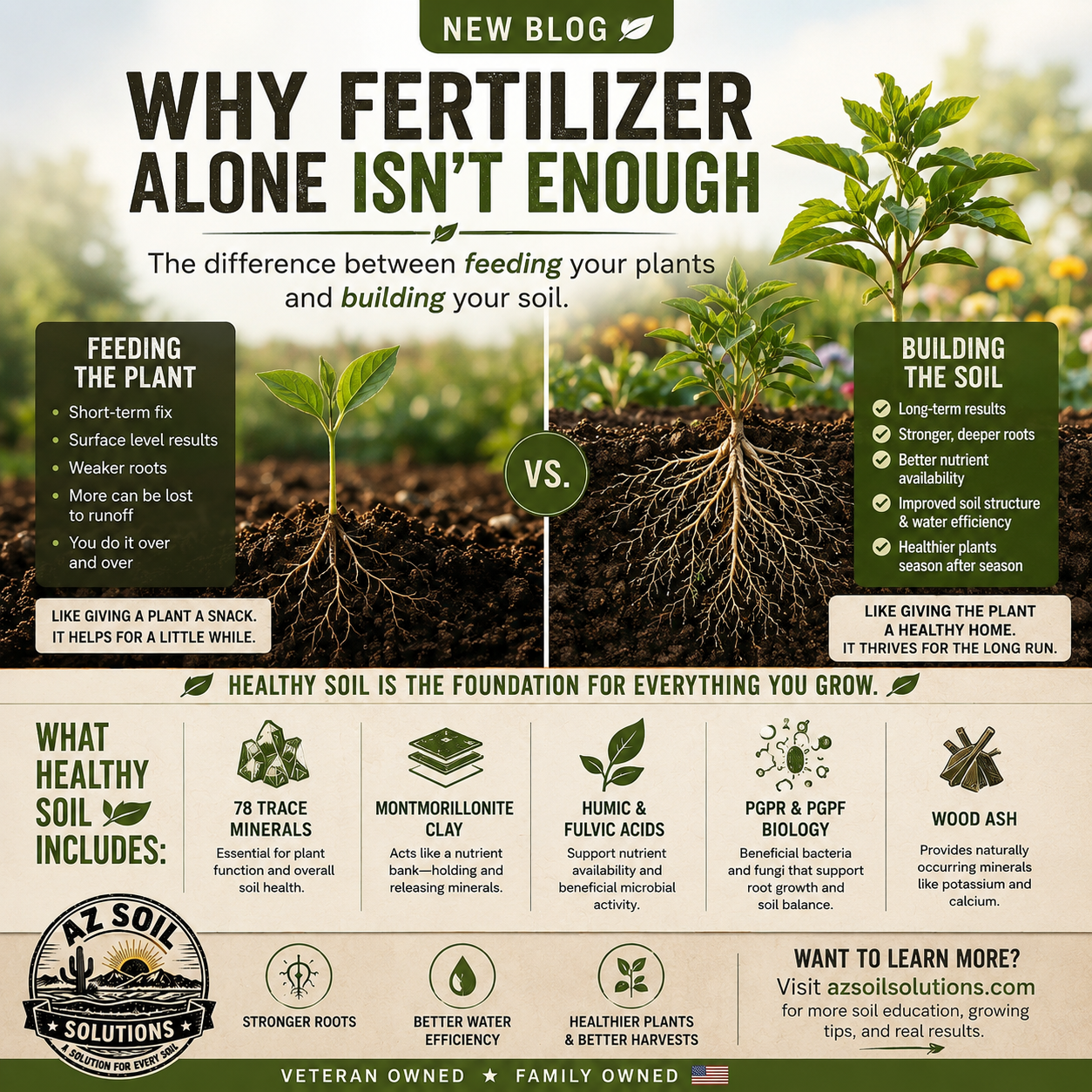
Feeding the Plant vs. Building the Soil
Traditional fertilizers typically emphasize three primary nutrients: nitrogen (N), phosphorus (P), and potassium (K). These are essential. Nitrogen drives vegetative growth, phosphorus supports energy processes, and potassium helps with water regulation and overall plant function.
Plants need them—but they need far more than just these three elements, and soil needs much more than fertilizer.
Think of building a house. You could install beautiful windows, high-end appliances, and a new roof, but if the foundation is crumbling, those upgrades won't fix the real problem. Soil works the same way. A plant can receive nutrients yet still struggle in compacted, biologically depleted, poorly structured soil that's low in organic matter and unable to hold or cycle nutrients effectively.
That's why the better question isn't simply “What should I feed my plant?” but rather:
“What does my soil need to support this plant?”
That small shift in perspective can transform gardening, farming, lawns, and landscaping.
Soil Isn't Just Dirt
Healthy soil is a thriving, complex ecosystem. It contains mineral particles, organic matter, air pockets, water, roots, fungi, bacteria, and countless microscopic organisms all interacting with one another.
Some microbes break down organic material. Others cycle nutrients. Many form close relationships with plant roots in the rhizosphere—the busy “neighborhood” right around the roots. Here, plants release compounds that influence nearby microbes, while beneficial microbes help make nutrients more available.
A plant doesn't grow in isolation. It grows as part of a living system. When we focus only on adding nutrients from above while ignoring what's happening underground, we feed the plant but neglect the foundation supporting it.
Meet the Underground Workforce
At AZ Soil Solutions, we frequently highlight two key groups: Plant Growth-Promoting Rhizobacteria (PGPR) and Plant Growth-Promoting Fungi (PGPF).
These beneficial microorganisms live in and around the root zone. Certain PGPR improve nutrient availability and support root development. Beneficial fungi enhance nutrient uptake and help plants become more resilient.
Think of a plant's root system as a growing business. The roots do the heavy lifting, but they don't have to do it alone. These specialized microbes act as a skilled support team—processing resources, unlocking nutrients, and strengthening the entire underground environment. The stronger the system, the better the foundation for the plant above.
The Missing Mineral Conversation
While N-P-K gets most of the attention, plants also require a broad range of trace minerals—elements like iron, manganese, zinc, copper, boron, and molybdenum. Though needed in tiny amounts, they are critical for many biological processes.
Remove one small gear from a watch and the whole mechanism can fail. Plant nutrition works similarly. That's why our formulation includes a broad spectrum of 78 naturally occurring trace minerals.
The goal isn't to replace responsible fertilization, but to support a more complete soil environment rather than viewing plant needs through just three numbers on a bag.
Having minerals present doesn't guarantee plants can access them. Soil pH, chemistry, biological activity, root health, and physical structure all play vital roles. Improving the environment where nutrient cycling happens is often more effective than simply adding more nutrients.
Why Our Montmorillonite Clay Matters
A cornerstone of AZ Soil Solutions is our naturally chelated montmorillonite clay. We describe its layered, highly porous structure as a microscopic “coral reef” for the soil.
This structure creates enormous surface area and acts as a natural nutrient bank, holding positively charged nutrients and releasing them as needed. It works hand-in-hand with humic and fulvic substances in our blend, supporting long-term soil chemistry and biology rather than providing a short-term feeding boost.
And Then There's Wood Ash
Our formulation also includes wood ash, which supplies minerals such as calcium and potassium. Used in agriculture for generations, wood ash can raise soil pH, so it must be applied thoughtfully—especially in already alkaline soils.
No single ingredient is a magic bullet. It's the complete, balanced system—minerals, clay, humic/fulvic substances, beneficial biology, wood ash, and the existing soil itself—that creates meaningful, lasting results.
A Different Way to Think About Growth
Garden centers are filled with products promising quick, visible results: greener lawns, bigger flowers, larger vegetables. There's nothing wrong with wanting those outcomes—we want them too.
But the conversation should start earlier. Before asking how to make the tomato bigger, ask how to make the root zone healthier. Before chasing a greener lawn, consider what's happening in the soil beneath the grass.
This approach shifts us from reacting to symptoms above ground to building strength from below.
Healthy Soil Changes the Water Conversation
We often focus on how much water to apply, but rarely ask what happens to that water once it hits the ground. In compacted or poorly structured soil, water may run off, evaporate, or fail to reach deeper roots.
Healthy soil creates pores and channels that allow water and air to move effectively. Roots gain better access to moisture and oxygen—much like the difference between pouring water on concrete versus a sponge. Stronger soil structure leads to more resilient plants and more efficient irrigation.
More Fertilizer Isn't Always the Answer
When a plant struggles, the common response is to add more fertilizer. But what if the real issues are compaction, imbalanced pH, poor water movement, limited biology, or nutrients that are present but unavailable?
Excessive fertilizer can even cause salt buildup, nutrient imbalances, or environmental losses. Fertilizer is a valuable tool, but it works best as part of a broader soil-building strategy.
At AZ Soil Solutions, we encourage people to move beyond “What should I add?” and start asking, “How can I improve the environment where my plants are growing?”
Build the House Before Decorating It
You wouldn't renovate an old house with new paint and furniture while ignoring a failing foundation. Soil deserves the same priority. Before chasing bigger blooms or greener grass, ensure the underground environment supports healthy roots, water infiltration, air exchange, nutrient availability, and beneficial biology.
When you build from below, everything above ground benefits.
Building Soil Is a Long-Term Investment
Healthy soil doesn't happen overnight—and that's a feature, not a bug. Roots expand gradually. Organic matter breaks down over time. Microbial communities adapt. Soil structure improves season after season.
Our blend is designed for sustained results. It combines 78 trace minerals, montmorillonite clay, humic and fulvic substances, beneficial PGPR and PGPF, and wood ash. Each component supports the others, creating a stronger foundation that plants can rely on year after year.
What Can You Do at Home?
You don't need to be a soil scientist to start improving your soil.
- Observe: Does water soak in or run off? Is the soil hard and compacted? Are roots shallow?
- Test your soil to understand pH and nutrient levels.
- Use organic materials wisely and protect soil from unnecessary disturbance.
- Focus on balanced irrigation and root development.
- Remember: more isn't always better. The goal is understanding and balance.
A Solution for Every Soil
Our tagline—“A Solution for Every Soil”—doesn't mean every soil has the same needs. Arizona desert soil differs from Midwestern loam. Clay soils present different challenges than sandy ones. Raised beds, lawns, and commercial landscapes each require their own thoughtful approach.
That's why education is central to what we do. Our Resources section covers soil biology, the soil food web, minerals, water, and more—so you can make informed decisions tailored to your unique conditions.
Stop Chasing the Plant. Start Building the Foundation.
Fertilizer still has an important place. Plants need nutrients. But it shouldn't be the entire conversation.
We need to talk about roots, water, minerals, soil structure, and beneficial biology. We need to treat soil as the living foundation it truly is.
The next time your lawn, garden, or landscape struggles, pause before reaching for fertilizer. Ask:
“What's happening underneath it?”
That simple question can change everything. Because healthier plants don't start at the leaves, flowers, or fruit—they start with strong roots in healthy soil. Don't just feed this season's plants. Build the soil that will support seasons of growth to come.
Healthy Soil. Better Growth. A Solution for Every Soil.
Ready to build from below? See the AZ Soil Solutions Bio Mineral or tell us about your project for a custom recommendation.