When most people look at a garden, lawn, farm, or landscape, they notice what's growing above the ground—tomatoes ripening, a green lawn, new growth on a tree, flowers opening, vegetables filling a raised bed.
What they usually miss is the enormous activity happening underneath.
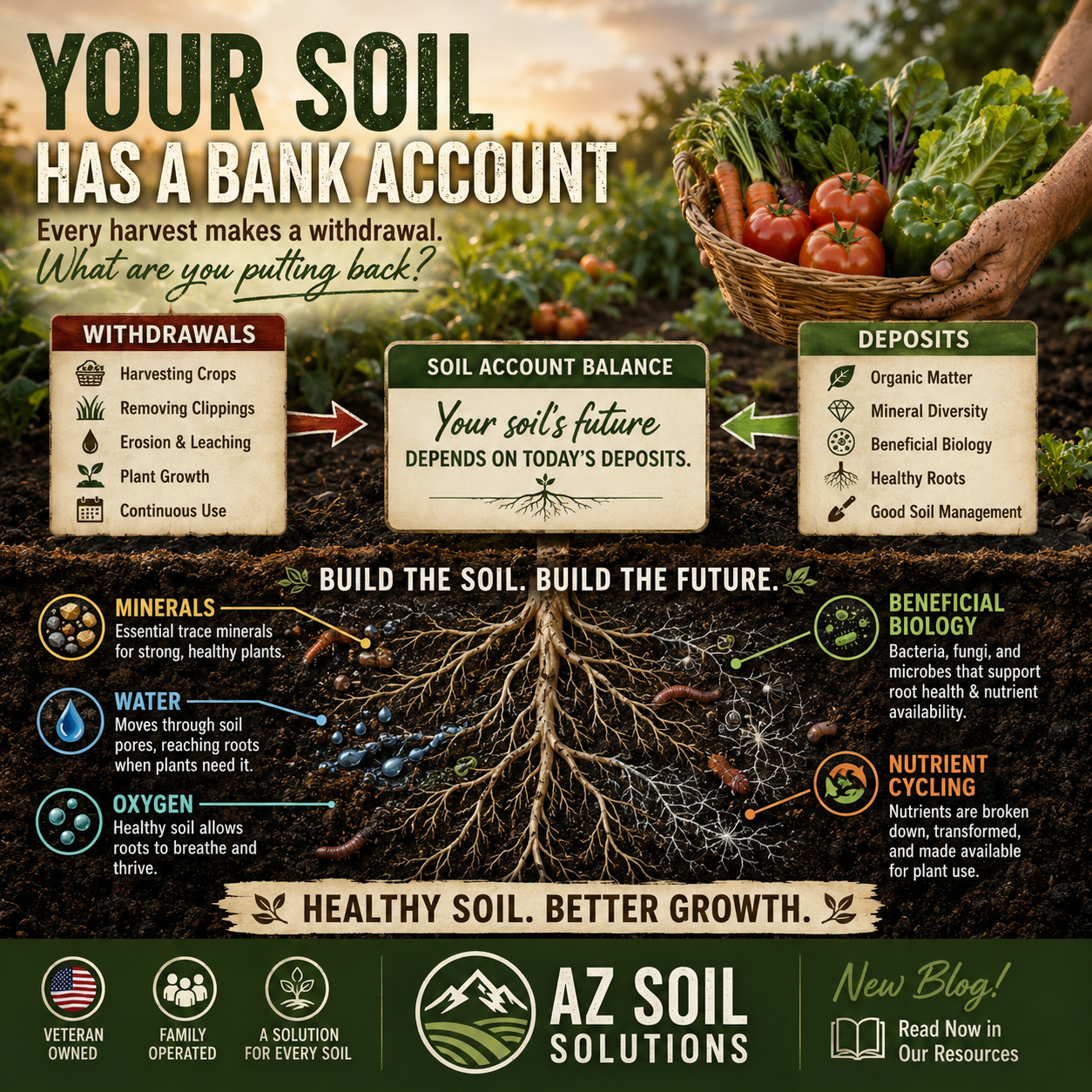
Every leaf, fruit, root, stem, and blade of grass requires resources to grow. Those resources come from the soil. Think of your soil as a bank account. Plants are constantly making withdrawals. The real question is whether you're making enough deposits to keep the account healthy.
Every Growing Season Costs Something
When a plant grows, it pulls water and nutrients from the soil through its roots. Those nutrients become part of the plant. Some eventually return when roots die, leaves fall, or organic material decomposes. Many do not.
Pick a tomato and carry it into the kitchen—part of what was once in your soil leaves with it. Harvest a basket of peppers? Another withdrawal. Remove end-of-season vegetables, bag lawn clippings, or prune trees and haul the material away? More withdrawals.
On farms the scale is larger still: crops are grown, harvested, loaded onto trucks, and transported elsewhere. The soil helped build that biomass, yet much of it never comes back.
One withdrawal doesn't destroy a healthy soil system. The problem arises when withdrawals continue year after year while deposits become limited.
The N-P-K Trap
Walk through almost any garden center and you'll see three numbers printed prominently on fertilizer bags: N–P–K (nitrogen, phosphorus, potassium). All three are essential. But plants and soil systems are far more complex than three elements.
Plants interact with calcium, magnesium, sulfur, iron, manganese, zinc, copper, boron, molybdenum, and numerous other mineral elements. Then there is the biological side: bacteria, fungi, mycorrhizal relationships, organic matter, root exudates, enzymes, earthworms, water, oxygen, and soil structure. Everything interacts.
Adding N-P-K can be useful when those nutrients are deficient. Repeatedly supplying only three nutrients, however, should not be confused with rebuilding the entire soil ecosystem. Imagine withdrawing from dozens of accounts while depositing into only three. Eventually the balance sheet becomes skewed. We covered this in depth in Why Fertilizer Alone Isn't Enough.
Soil Doesn't Just Hold Nutrients
Healthy soil is not simply dirt containing fertilizer. It is a physical, chemical, and biological environment. Structure determines how easily roots can move through it. Pore spaces influence whether water infiltrates or runs off and how much oxygen reaches the root zone. Clay and organic matter affect the soil's ability to retain and exchange nutrients. Microorganisms drive decomposition and nutrient cycling. Fungal networks interact with plant roots.
Two soils containing similar amounts of a given nutrient can perform very differently. Presence does not equal availability. Biology, water, root health, and structure all matter. The account is not just about how much is in the bank—it's about whether the plant can actually access it.
Some Withdrawals Happen Quietly
Harvesting is obvious. Other losses are quieter. Heavy rainfall or excessive irrigation can move nutrients deeper into the profile. Wind and water erosion remove topsoil. Repeated disturbance damages structure. Low organic matter reduces the soil's ability to function as a biological habitat. Extreme heat stresses plants and soil organisms.
Sometimes we unintentionally remove exactly what could replenish the system—leaves hauled away, grass clippings bagged, plant residues discarded instead of composted or returned. None of these practices is automatically wrong (disease or pests often require removal). The important point is balance. If material continually leaves the system, something eventually needs to come back.
Your Plants May Be Giving You Clues
When plants struggle, the first instinct is often “What fertilizer should I add?” Sometimes fertilizer is the answer. Often the better question is “What's happening in the soil?”
A struggling plant can be affected by water management, temperature, compaction, drainage, pH, root damage, disease, nutrient availability, soil biology, pollination, or a combination of factors. Simply adding more fertilizer is not always the solution.
Before adding another product, look at the entire system. Dig into the soil. Examine the roots. Observe how quickly water infiltrates. Consider organic matter levels. Get a soil test when appropriate. Ask what has been removed over the years—and what has actually been returned. Your plants may be showing you the balance sheet. Sometimes the problem isn't what you're doing above the ground. It's what the soil account looks like below it.
Making Deposits: Rebuilding the Soil Account
How do we make deposits? The answer is not simply pouring more fertilizer onto the ground. Building better soil means thinking about the entire system: minerals, organic matter, biology, water, oxygen, structure, and roots. A healthy soil account is not built with one enormous deposit. It is built through consistent management that helps the soil function as a living system.
Deposit #1: Return Organic Matter
Compost, plant residues, mulches, roots, and other organic materials provide carbon and resources that become part of the soil as they break down. Bacteria, fungi, earthworms, and other organisms drive that process while cycling nutrients. Organic matter also improves water retention, aggregation, and structure. Nature rarely leaves productive soil completely exposed. A healthy forest floor is covered with leaves, twigs, and decomposing material at different stages of breakdown. Your garden need not look like a forest floor, but the principle holds: what grows from the soil can often help feed the soil again.
Deposit #2: Think Beyond Three Nutrients
Nitrogen, phosphorus, and potassium are essential, yet they are not the entire nutritional story. Calcium, magnesium, sulfur, iron, manganese, zinc, copper, boron, molybdenum, and other trace elements all participate in plant and soil processes. Some are needed in relatively large quantities; others only in tiny amounts. “Tiny” does not mean unimportant. Remove the wrong small component from a complex machine and the whole system can falter.
When replenishing soil, the goal should not automatically be “How much fertilizer can I add?” A better question is “What does this soil actually need?” Soil testing and careful observation become valuable here. More is not always better. Balance matters.
Deposit #3: Support the Biology
Plants do not operate alone. The rhizosphere—the zone immediately surrounding roots—is an active biological environment. Roots release compounds; microorganisms live and interact there. Certain bacteria and fungi participate in nutrient cycling, root development, and plant-soil interactions.
Instead of seeing a plant as an isolated organism growing in dirt, picture it at the center of a massive underground community of roots, bacteria, fungi, minerals, water, air, and organic matter. Building soil is not simply about feeding the plant. It is about improving the environment around the root system. Our article on the soil food web walks through that community in detail.
Deposit #4: Build a Better Home for Roots
Even nutrient-rich soil creates problems if roots cannot effectively explore it. Compaction reduces pore space. Poor drainage limits oxygen. Extremely loose soils may struggle to retain water and nutrients. Damaged structure affects water movement. Roots need room to expand; microorganisms need habitat.
Clay minerals and organic matter are particularly important here. Certain clay particles offer enormous surface area relative to their size and interact with nutrients and water. What looks like a handful of dirt is, at the microscopic level, an enormous three-dimensional landscape of surfaces, pores, channels, aggregates, root pathways, water films, and microbial habitats.
Deposit #5: Keep Nutrients Cycling
A healthy soil account is not merely about storing nutrients—it is about cycling them. Nutrients continually move between organic matter, microorganisms, soil particles, water, and plants. A fallen leaf decomposes. Microorganisms process the material. Nutrients are released or transformed. Roots interact with the surrounding soil. Plants grow. More organic material eventually returns. The cycle continues.
This is very different from treating soil as an empty container that periodically needs fertilizer poured into it. Good management supports the cycle itself. The ultimate goal is not to continually rescue struggling plants, but to create conditions where healthy growth has a stronger foundation from the beginning.
Where AZ Soil Solutions Fits
This philosophy is a major reason we developed the approach behind AZ Soil Solutions. We focus on the environment underneath the plants, not only what is growing above. Our soil enhancement blend combines several components intended to complement a broader soil-management program:
- 78 naturally occurring trace minerals to introduce mineral diversity
- Montmorillonite clay, valued for its surface area and nutrient-holding characteristics
- Humic and fulvic acids to support the soil environment and nutrient interactions
- PGPR and PGPF biological components, including Bacillus subtilis, focused on the root-zone biology
- Wood ash contributing additional mineral components
Important: No bag replaces good soil management. Water still matters. Organic matter matters. Drainage, temperature, pH, plant selection, biology, and knowing your soil all matter. Our goal is not to replace those fundamentals. It is to become another useful tool for people building a stronger foundation beneath their plants.
Stop Thinking About Feeding. Start Thinking About Building.
There is an important difference between feeding a plant and building soil. Feeding focuses on the immediate crop. Building focuses on the environment that will support this crop—and the ones that come after it.
Fertilizers still have a place. They should be one tool rather than the entire strategy. If your soil account is struggling, continually making larger withdrawals while relying on the same few deposits rarely solves the underlying problem.
Look at the whole balance sheet:
- What minerals are present? What is missing?
- How much organic matter is there?
- How does water move through the soil?
- Are roots able to penetrate deeply? Is the soil compacted?
- What biological activity is occurring around those roots?
- What are you removing every season—and most importantly, what are you putting back?
The Best Harvest Begins Long Before Harvest Day
When someone holds a beautiful tomato, pepper, or handful of vegetables, it's easy to think the story began when the seed was planted. It didn't. That harvest was shaped by what was happening in the soil long before the fruit appeared. The same is true for a green lawn, a thriving landscape, a productive farm, or a healthy tree. What we see above ground is often a reflection of conditions below it.
This season, don't only watch your plants. Watch your soil. Protect it. Test it when necessary. Return organic matter. Encourage healthy roots. Pay attention to water and structure. Think about mineral diversity. Support the biological processes occurring beneath your feet.
Every harvest makes a withdrawal.
What are you putting back?