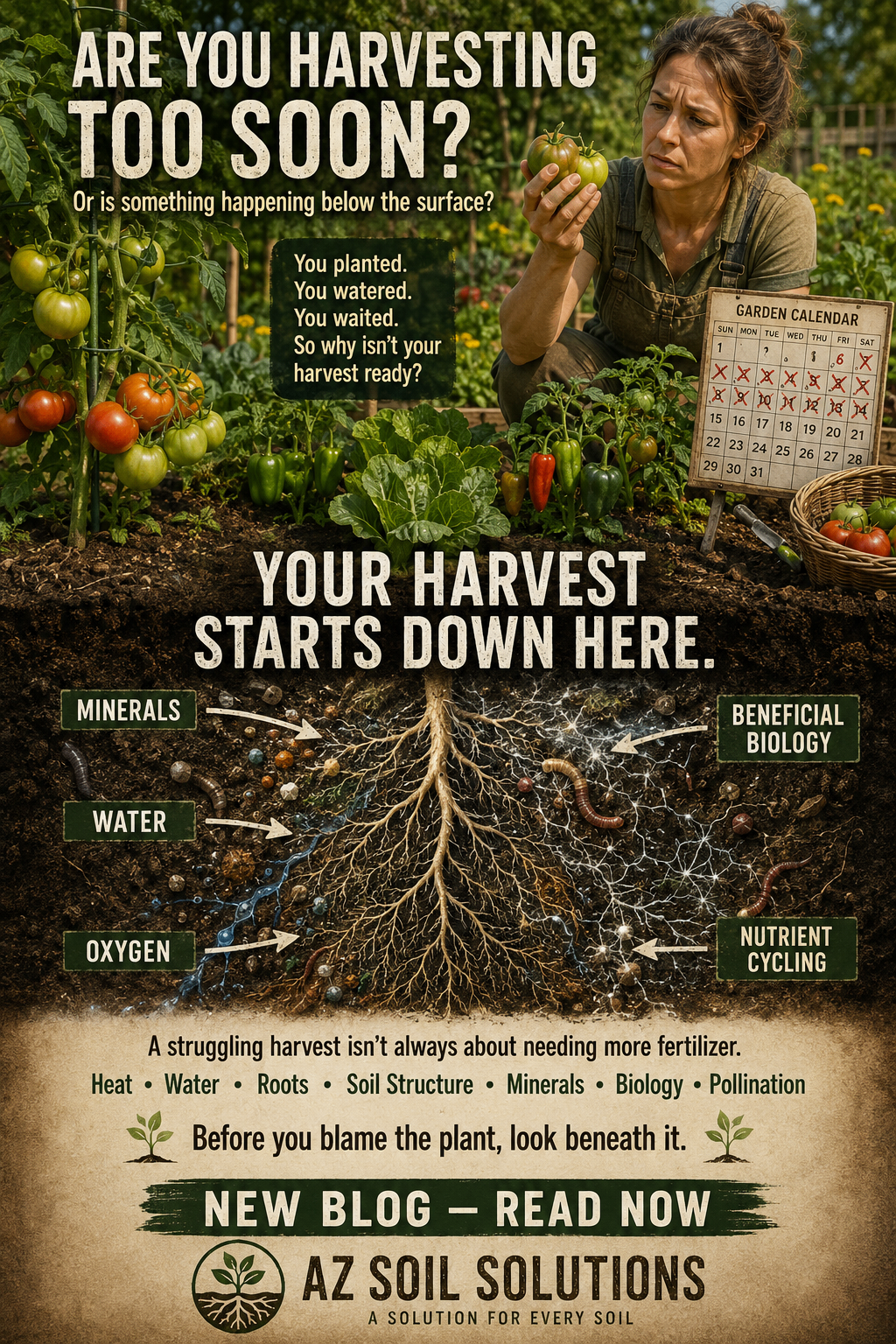
You planted on time. You watered. You watched the first leaves appear, celebrated the first flowers, and began imagining baskets filled with tomatoes, peppers, squash, cucumbers, or whatever else you put in the ground. Then you waited. And waited. The calendar says you should be getting close to harvest, yet your garden seems to have missed the memo. Tomato plants may be growing while the fruit takes forever to develop. Peppers may produce far less than expected. Vegetables might stay smaller than hoped, flowering can turn inconsistent, or the entire garden simply moves more slowly than it should. The natural question is whether you are harvesting too soon or whether something is wrong with the plants. There is another question worth asking: what is happening underneath them?
While we spend most of our time looking at leaves, flowers, and fruit, an enormous part of a plant's story unfolds where we cannot see it—inside the soil. That underground ecosystem, often called the soil food web, plays an important role in creating the conditions plants need to grow, develop, and eventually produce a harvest.
A Harvest Does Not Follow a Perfect Calendar
The number of days printed on a seed packet or plant tag is a guide, not a guaranteed harvest date. Plants do not own calendars. A tomato variety listed at 75 days is not necessarily going to deliver a perfectly ripe tomato exactly 75 days after it goes into the ground. Growing conditions, temperature, sunlight, water, planting time, pollination, and the specific variety all matter. Here in Arizona, extreme heat can completely change the equation. When temperatures become excessively hot, flowering and successful fruit set can suffer. A beautiful tomato plant can therefore remain alive and growing while producing far less fruit than a gardener expected. That is not necessarily a fertilizer problem or a soil-biology problem; sometimes it is simply the environment. But when the weather is reasonable, watering is appropriate, and the plant receives enough light, yet things still do not seem right, it becomes worth investigating the foundation.
Your Harvest Actually Begins Underground
We tend to think of a harvest as the final stage of gardening, yet the foundation for that harvest began months earlier—when the first roots entered the soil. Roots are not simply anchors holding plants upright. They are active biological structures that continuously interact with the environment around them. They need access to water and oxygen. They interact with mineral nutrients. And they exist alongside an enormous community of microorganisms. The narrow area of soil immediately surrounding plant roots, called the rhizosphere, is one of the most biologically active zones in the soil. Plants release compounds through their roots. Bacteria and fungi live and function around those roots. Organic materials decompose. Nutrients move through different forms. It is an underground exchange that takes place every day. That is why healthy soil is so much more than dirt—it is a functioning system.
Imagine walking into a forest. No one stands beside every tree pouring fertilizer around its trunk every few weeks, yet the system continues. Leaves fall, organic material decomposes, fungi grow, bacteria multiply, and insects and other organisms interact with decaying materials. Nutrients are continuously transformed and recycled. The soil food web describes many of these relationships between plants and soil organisms. It includes bacteria, fungi, protozoa, nematodes, arthropods, earthworms, and many other organisms, all interacting directly or indirectly. Some break down organic materials. Some consume other microorganisms. Some participate in nutrient cycling. Some interact closely with plant roots. Together they contribute to the complex environment in which plants grow. Think of your garden as a city. Your plants are the buildings you see above ground. Underneath those buildings lie roads, electrical lines, water systems, communication networks, and workers keeping everything functioning. If those systems begin breaking down, simply repainting the buildings will not fix the city. The infrastructure matters. Your soil is that infrastructure.
Nutrients Can Be Present Without Being Available
Having nutrients somewhere in the soil does not automatically mean a plant can access all of them whenever it wants. Nutrient availability is affected by soil pH, moisture, temperature, root health, mineral chemistry, and biological activity. This is why continually adding more fertilizer is not always the answer. Imagine having a refrigerator completely filled with food—but the refrigerator is locked. Technically you have plenty of food; practically you cannot eat any of it. Soil can present a similar challenge. Certain nutrients may exist in the ground but remain in forms or conditions that limit plant uptake. That is one reason soil biology matters.
Microorganisms participate in decomposition and nutrient transformations that influence how nutrients move through the soil ecosystem. Instead of asking only how many nutrients you put into the garden, it is equally important to ask how effectively the soil system is cycling and supplying those nutrients to the roots. Those are two very different questions.
PGPR, PGPF, and the Microscopic Workforce
Two groups that are especially important to the philosophy at AZ Soil Solutions are Plant Growth-Promoting Rhizobacteria (PGPR) and Plant Growth-Promoting Fungi (PGPF). The terminology sounds complicated, yet the concept is straightforward. Certain beneficial bacteria and fungi can interact with plants and the root-zone environment in ways that support plant growth and nutrient processes. Think of the root system as a factory. The roots are doing tremendous work, but they are surrounded by microscopic workers performing other jobs throughout the system. Some microorganisms help break down materials. Some influence nutrient availability. Others interact with root development or compete within the microbial community. The goal is not simply to have “more microbes.”
The goal is to create conditions where a diverse and functional soil ecosystem can operate. Healthy soil is not about dumping bacteria into unhealthy ground and expecting magic. Biology needs an environment capable of supporting it—moisture, appropriate temperatures, food sources, and habitat.
Soil Structure Affects the Entire System
Take two gardens growing the exact same tomato variety. One has soil that allows water to infiltrate, contains pore spaces for air, supports root expansion, and provides a healthy environment for biological activity. The other has hard, compacted ground where water struggles to penetrate and roots remain confined near the surface. Even if both gardeners apply the same fertilizer, those plants are not growing under the same conditions.
The environment around the roots matters. Healthy soil structure allows for a balance of air and water. Roots need oxygen too. Structure also influences how deeply roots can explore the soil profile. A larger, healthier root system gives the plant access to a greater volume of soil from which it can obtain water and nutrients. That becomes especially important during stressful conditions. When temperatures climb and the upper portion of the soil begins drying rapidly, a plant with a well-developed root system may reach resources that a shallow-rooted plant cannot. This does not make a plant invincible, but it can give it a stronger foundation.
So Is Your Soil Food Web “Behind”?
Not exactly. The soil food web is not running against a stopwatch. There is no universal biological schedule that says a certain number of bacteria or fungi must be present by Day 45 for tomatoes to ripen on Day 75. Instead, think of the soil food web as part of the support system that helps create favorable conditions for plant growth. If soil biology, root development, water management, soil structure, or nutrient availability are struggling, plant performance may suffer. A delayed harvest, however, does not automatically prove that the soil food web is unhealthy. Before adding anything to the garden, look for clues. Is the plant actively growing? Are the leaves healthy? Are flowers forming or dropping? Is fruit setting but ripening slowly? Does water penetrate the soil or run across the surface? Is the ground constantly saturated or does it dry almost immediately? Are roots able to penetrate deeply? What is the soil pH? What have you already applied? Every answer tells you something.
One of the easiest mistakes gardeners make is becoming so focused on the harvest that they stop looking at everything leading up to it. We see a green tomato and wonder why it is not red yet. The better investigation starts much earlier. Look at the leaves, new growth, flowering, the soil, irrigation, insects, and disease symptoms. Consider recent temperatures and when the plant was actually transplanted. Most importantly, remember what is happening underneath the surface. The tomato hanging from the vine is the final chapter of a much longer story that began with the soil. Your harvest does not begin when the fruit appears. It begins beneath the soil. Roots, minerals, microorganisms, water, air, temperature, and soil structure all contribute to the environment supporting your plants.
Soil Is Constantly Changing
Extreme temperatures, excessive watering, drought, compaction, repeated disturbance, low organic matter, nutrient imbalances, and other environmental conditions can influence what happens around plant roots. This is especially true in challenging climates. During extreme heat the soil surface can become incredibly hot, moisture can disappear quickly, plants can become stressed, and biological processes can shift. Keeping soil constantly saturated creates another set of problems, because roots need water but they also need oxygen. Healthy soil is not simply about adding more of everything. It is about balance. More fertilizer is not always better. More water is not always better. More amendments are not always better. The goal is to create an environment where the plant and the biological system surrounding its roots have what they need to function.
When a garden is not producing on schedule, one of the first instincts is often to assume it must need fertilizer. Sometimes that is true. But if a tomato plant is struggling because its roots sit in compacted soil with poor drainage, more fertilizer will not fix the compaction. If the plant is dropping flowers because daytime and nighttime temperatures fall outside the range favorable for fruit set, more fertilizer will not change the weather. If soil pH is limiting the availability of a particular nutrient, simply adding more of that nutrient may not address the underlying chemistry. This is why we encourage growers to diagnose before they react. Look at the entire plant and its environment. Sometimes a soil test can tell you far more than another bag of fertilizer ever could.
Minerals, Clay, and the Whole System
Plants require numerous mineral elements to perform normal biological functions. That is one reason AZ Soil Solutions contains a broad spectrum of 78 naturally occurring trace minerals. Yet the presence of minerals alone does not guarantee plant availability. Soil chemistry, pH, moisture, roots, and biological processes all influence nutrient availability. Our philosophy is not simply about adding minerals. It is about supporting the environment in which those minerals, roots, water, and biology interact. Think of an orchestra. You can have the best violinist in the world, but one musician does not create a symphony. The power comes from many different pieces working together. Soil is remarkably similar.
Our blend also contains humic and fulvic substances associated with decomposed organic materials. These substances interact with minerals and influence characteristics of the soil environment. No single ingredient is the answer. That is an important part of the AZ Soil Solutions philosophy. We are not looking for one “miracle ingredient.” We are interested in how the system works together—minerals, clay, organic compounds, biology, water, air, and roots. All of them matter.
This brings us back to PGPR and PGPF. Certain beneficial bacteria and fungi can interact with plants and participate in processes around the root zone that support plant growth and nutrient cycling. But microorganisms also need a suitable environment. Adding beneficial biology while ignoring everything else happening in the soil misses the bigger picture. It is like releasing fish into a pond without considering whether there is enough water, oxygen, food, or suitable habitat. The environment has to support the biology. Building soil is not about one application or one ingredient. It is about creating conditions where biological processes can function alongside healthy roots.
Wood ash is another component of our formulation. It can contribute minerals including potassium and calcium, yet it also deserves respect because wood ash can influence soil pH. This is particularly important in Arizona, where many native soils are already alkaline. More is not automatically better. That is exactly why we believe amendments should be used intentionally and according to appropriate application rates. If you do not know what is happening in your soil, testing can be extremely valuable. Understanding your starting point helps you make better decisions about what your soil actually needs.
Where to Start
You do not need a microscope or a degree in soil science to begin taking better care of the ecosystem beneath your garden. Start with observation. Pay attention to how quickly your soil dries. Notice whether water penetrates or runs off. Protect exposed soil where appropriate with mulch or plant cover. Avoid unnecessary compaction. Add appropriate organic materials when needed. Use irrigation intentionally rather than assuming more water means healthier plants. Avoid repeatedly disturbing the soil when it is not necessary. Consider soil testing. And perhaps most importantly, give the system time. Healthy soil is not built overnight. Neither are strong root systems. Nature works through processes, relationships, and cycles. That is one reason we believe soil health should be viewed as a long-term investment rather than a quick fix.
So we return to the original question: are you harvesting too soon, or is your soil food web falling behind? The answer may be neither. Your tomato may simply need another week. Your pepper variety may naturally take longer. Extreme heat may have temporarily slowed fruit set. Pollinators may have been scarce. Your watering schedule may need adjustment. Or yes—the environment surrounding your roots may need attention. The key is not assuming every slow harvest has the same cause. That is what separates reacting from understanding. Instead of immediately adding more fertilizer, start asking questions. What has the weather been doing? How does the plant look overall? Is it flowering and setting fruit? What does the soil feel like several inches down? How often are you watering? When did you actually transplant? What variety are you growing? What is happening with the rest of the garden? Those clues can help you understand whether you are dealing with normal plant development or a deeper growing problem.
Gardening teaches patience better than almost anything else. You can prepare, plant, water, and build healthier soil, but ultimately you are working with a living system. There will always be variables outside your control. That is part of growing. Our goal at AZ Soil Solutions is not to promise that adding something to your soil will suddenly make a tomato ripen next Tuesday. That is not how nature works. Our goal is to help support something much more fundamental: the environment beneath the plant. Our blend of 78 naturally occurring trace minerals, montmorillonite clay, humic and fulvic substances, beneficial PGPR and PGPF biology, and wood ash was developed around that philosophy. Support the soil. Support the roots. Support the biological system. Then give the plant the opportunity to do what it was designed to do.
When you finally walk into your garden and pick that first ripe tomato, pepper, cucumber, squash, or handful of herbs, it is easy to think that is when the work paid off. But the story started much earlier—beneath your feet. With roots pushing into the soil. With water moving through tiny pore spaces. With minerals interacting with soil particles. With microorganisms functioning around the root zone. With an entire underground ecosystem quietly supporting what eventually appeared above the surface. The next time your harvest seems late, do not immediately assume you have failed or that your plants simply need another dose of fertilizer. Look beneath the surface. Ask what your roots are experiencing. Ask what your soil may be missing. Ask whether you are feeding only the plant or supporting the entire system that plant depends upon. Sometimes the most important part of your harvest is the part you will never see.
Before you blame the plant, look beneath it.
Feed the system. Support the roots. Let the harvest follow.
Healthy Soil. Stronger Roots. Better Harvests.
Want help reading your own ground? See the AZ Soil Solutions Bio Mineral or tell us about your project.