The morning finally feels different.
You step outside with a cup of coffee, and for the first time in what feels like months, the air doesn't immediately feel like it's coming from an oven.
Summer isn't completely gone. The afternoons are still warm, and the ground is holding onto months of heat. But there's something about that cooler morning that tells every gardener the same thing: fall is coming.
Almost immediately, you start thinking about what you're going to plant. Maybe it's lettuce and spinach. Broccoli and cauliflower. Carrots, radishes, onions, herbs, or flowers. Maybe this is finally the season you're going to build that raised garden bed you've been talking about all summer.
Before long, you're standing at the garden center looking at seed packets and young transplants, imagining what that empty patch of ground could look like a few months from now.
You bring everything home. You dig your holes. You plant. You water. And then you wait.
For the first week, everything looks promising. Then one plant begins to yellow. Another stops growing. One wilts every afternoon even though you've been watering it. You notice the soil looks wet on top, but when you dig down a few inches, it's surprisingly dry. Somewhere else in the garden, water pools instead of soaking into the ground.
So you do what gardeners have been taught to do for generations. You reach for fertilizer.
But what if the plant isn't hungry? What if the problem started before you ever put it in the ground?
Your Fall Garden Started Weeks Ago
Most gardeners think planting day marks the beginning of a garden. It doesn't.
Long before the first seed germinates or a transplant sends a new root into the surrounding soil, the environment that root will encounter has already been established.
The soil already has a structure. It already has, or lacks, adequate pore space for air and water. It contains a community of microorganisms, or perhaps a depleted one. Nutrients may be present, deficient, or unavailable to the plant because of other soil conditions.
And after months of summer heat, irrigation, drying cycles, foot traffic, and previous plant growth, that underground environment may be very different from the one you had in spring.
That's why fall garden preparation shouldn't begin with the plant. It should begin with the soil.
Take a Trip Underground
Imagine for a moment that you could shrink yourself down and follow the first young root emerging from a newly planted transplant.
Above ground, everything looks simple. There's sunlight, water, green leaves, and a gardener hoping for a great harvest. Underground, however, that tiny root is entering an incredibly complicated world.
As it grows, it must move through spaces between soil particles. It needs access to moisture without being constantly waterlogged. It needs oxygen for root respiration. It encounters minerals, organic matter, bacteria, fungi, and countless other microscopic organisms.
If the soil is loose and well-structured, that young root has room to explore. If the soil is severely compacted, expansion becomes more difficult. If water drains too quickly, the root may struggle to remain hydrated. If water sits around the root for too long, oxygen can become limited. And even if nutrients are present in the soil, that doesn't automatically mean the plant can access all of them efficiently.
Suddenly, that little transplant from the garden center doesn't seem quite so simple. The plant you see above ground is only half the story.
What Did Summer Leave Behind?
Summer can be brutal on a garden, especially in hot, dry climates.
We usually notice the obvious effects above ground: scorched leaves, wilted plants, dry lawns, and struggling vegetables. But the soil experiences summer too.
Repeated cycles of extreme heat, drying, and irrigation can influence soil conditions. Bare soil can become extremely hot. Heavy foot traffic can contribute to compaction. Irrigation patterns can move salts through the soil profile, and some soils can develop surfaces that resist water infiltration. Biological activity is also influenced by temperature and moisture. Much of this is amplified by the conditions we cover in Why Arizona Soil Is Different.
So when fall approaches, don't assume your garden soil is automatically ready simply because the weather is beginning to cool. Go outside and investigate it.
Push a garden trowel into the ground. Does it penetrate easily? Dig several inches down after watering. Is moisture moving into the root zone, or is only the surface getting wet? Pick up a handful. Does the soil crumble and contain visible organic material, or is it hard and compacted?
Sometimes five minutes spent examining the soil tells you more than staring at a struggling plant for a week.
Watering Isn't the Same as Hydration
This is one of the most important distinctions for gardeners to understand: you can water a garden without effectively hydrating its root zone.
If soil is compacted, water may run across the surface. If the soil structure is poor, water movement can be uneven. If you're watering very shallowly, plants may develop shallow root systems concentrated near the surface. And if the soil stays saturated for prolonged periods, roots can experience low-oxygen conditions.
The goal isn't simply more water. It's creating soil conditions that allow an appropriate balance of water and air.
Before planting your fall garden, water the area and then dig into it. See how far the moisture actually traveled. You might be surprised by what you find.
Roots Need Oxygen Too
When we think about what plants need, we usually think of sunlight and water. But healthy roots also require oxygen. Roots use oxygen during cellular respiration, which provides energy needed for growth and nutrient uptake.
Healthy soil structure creates pore spaces that can contain both air and water. When those spaces disappear because of severe compaction, or remain filled with water for too long, the root environment changes dramatically.
This is one reason repeatedly adding fertilizer may not solve a struggling plant. You can add nutrients to the soil, but if the root environment itself is unhealthy, the plant may still struggle.
Sometimes the better question isn't “What should I feed this plant?” It's “What environment are its roots living in?”
Organic Matter Is Important, But It's Not the Entire Story
Adding compost and other appropriate organic materials can be one of the best things gardeners do for their soil. Organic matter can support soil organisms, influence water-holding characteristics, and contribute to improved soil structure.
But healthy soil isn't made from organic matter alone. A functioning soil system also involves minerals, microorganisms, water, air, soil particles, plant roots, and organic compounds interacting together.
Think about healthy soil like a community. You can't build a thriving community with only one resource. The different pieces have to work together.
That's why fall preparation should look beyond simply adding fertilizer, or even simply adding compost. We're trying to create a better root environment. We break that down further in Why Fertilizer Alone Isn't Enough.
Minerals: The Part of Soil We Often Forget
Most gardeners recognize the letters N-P-K. Nitrogen. Phosphorus. Potassium.
All three are essential plant nutrients, but they aren't the complete nutritional picture. Plants also depend on secondary nutrients and micronutrients for important biological processes involving enzymes, photosynthesis, structural development, and metabolism.
Some are required only in very small quantities. Small doesn't mean unimportant.
Think about the human body. We need certain vitamins and minerals in tiny amounts compared with carbohydrates, proteins, and fats, but deficiencies can still matter. Plants are similar.
A healthy soil-management strategy therefore isn't simply about dumping large quantities of three nutrients into the ground. It's about understanding the broader soil system.
Meet the Underground Workforce
Now return to that young root growing through your fall garden. This time, imagine zooming in even further.
Around that root is an area called the rhizosphere, a biologically active zone influenced by the plant's roots. Plants release compounds through their roots that interact with surrounding microorganisms. Beneficial bacteria and fungi can participate in nutrient cycling and other processes occurring around the root system.
Mycorrhizal fungi, for example, form associations with the roots of many plant species and can extend fungal structures beyond the immediate root surface. Bacteria occupy microscopic spaces throughout the soil. Organic matter becomes food for parts of this underground ecosystem. Predators feed on other microorganisms. Nutrients are transformed and recycled.
What looks like dirt from above can actually be an extraordinarily active ecosystem, which we map out in The Soil Food Web.
This is why we talk so much about feeding the soil instead of simply feeding the plant. You're supporting an entire system.
Don't Wait Until Planting Day
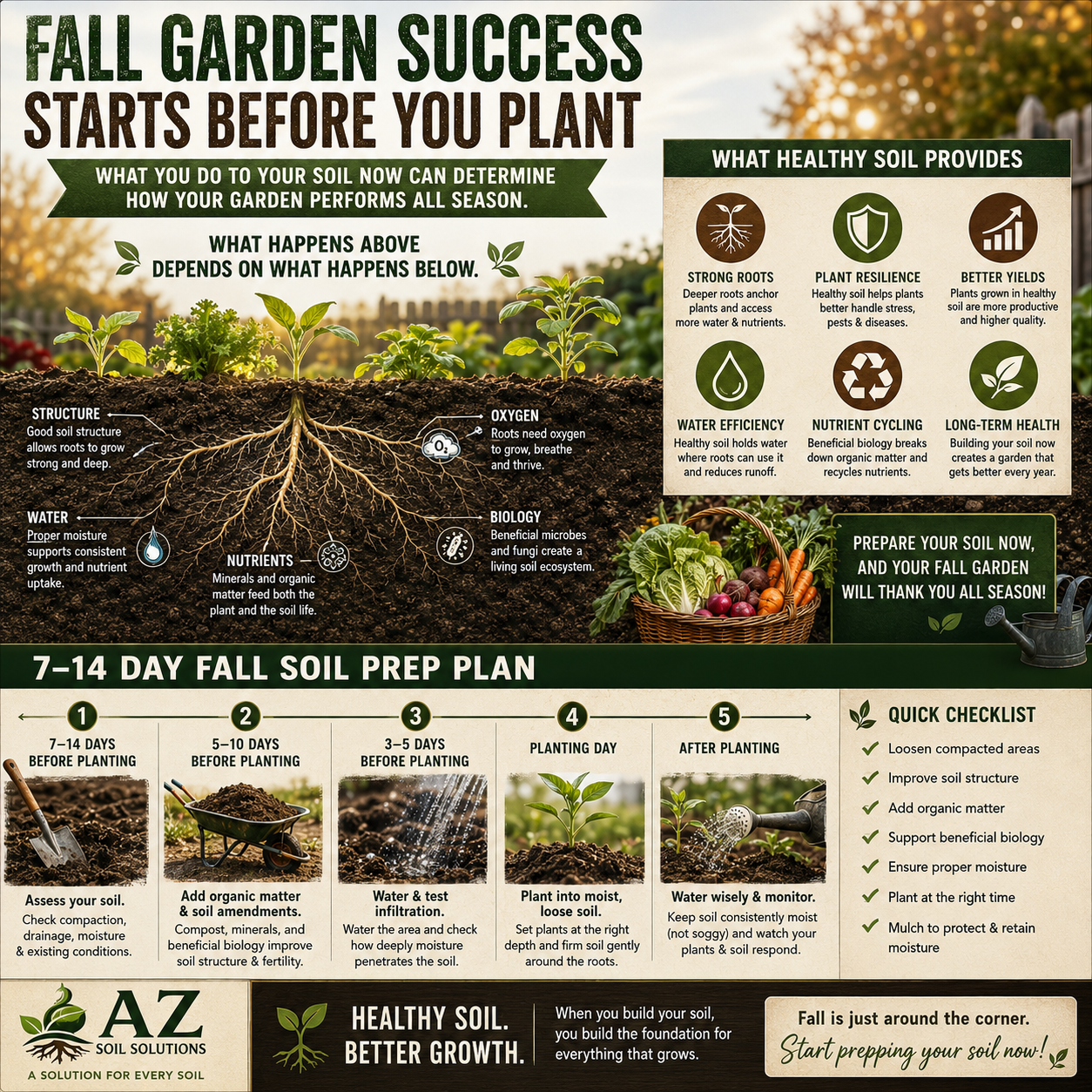
If possible, begin preparing your fall planting area one to two weeks before planting. You don't need to make the process complicated.
Start by removing weeds and old plant debris that shouldn't remain. Inspect your irrigation. Check drainage. Loosen compacted areas appropriately without unnecessarily destroying existing soil structure. Incorporate mature compost or other organic matter when your soil needs it. Evaluate your soil pH or nutrient status if you've experienced recurring problems or are growing crops with particular requirements.
Then focus on creating a root zone with adequate moisture, air, structure, minerals, and biological activity. After you've prepared the area, water it appropriately and give the soil some time before planting.
You're preparing the home before the new resident arrives.
A Simple Fall Soil-Prep Plan
- 7 to 14 days before planting: Inspect the planting area. Check compaction, drainage, irrigation coverage, and existing soil condition. Remove weeds and problematic plant debris.
- 5 to 10 days before planting: Add appropriate compost, soil amendments, or other materials based on what your soil actually needs. Work them into the root zone according to their directions rather than leaving everything concentrated on the surface.
- Several days before planting: Water the area and check infiltration. Dig down afterward and see where the moisture actually went.
- Planting day: Plant into moist, not waterlogged, soil. Avoid unnecessarily compacting the area around the root system.
- After planting: Monitor the soil rather than watering strictly by habit. Young plants need consistent moisture while establishing, but different plants and soils require different watering schedules.
And most importantly: watch the plant and the soil together. The leaves tell you part of the story. The roots and soil tell you the rest.
Where AZ Soil Solutions Fits In
This philosophy is exactly why we created AZ Soil Solutions Premium Soil Enhancement. We didn't want to create another product focused solely on producing a temporary burst of top growth. We wanted to focus on the environment beneath the plant.
Our concentrated blend brings together 78 naturally occurring trace minerals, montmorillonite clay, humic and fulvic acids, beneficial PGPR biology, PGPF enzyme fermentation extracts, and wood ash. Each component contributes something different to the soil environment.
Montmorillonite clay has properties that allow it to hold exchangeable nutrients. Humic substances interact with soil chemistry and can support nutrient availability and soil structure. Trace minerals broaden the mineral profile beyond the familiar N-P-K conversation. And beneficial biological components are included because soil isn't merely a collection of minerals. It's an ecosystem.
Our goal isn't to replace good gardening practices, proper irrigation, compost, or appropriate fertilization. It's to complement them by helping gardeners focus on the foundation underneath everything they're trying to grow.
Fall Is an Opportunity to Start Again
Now imagine that cool morning one more time. You walk outside with your coffee.
The seed packets are still sitting on the counter. The transplants haven't been purchased yet. Nothing has gone into the ground.
But this time, instead of heading straight to the garden center, you walk into the garden first. You kneel down. You push your fingers into the soil. You look at its structure. You check the moisture. You think about what's happening several inches beneath your hand.
And suddenly, the empty garden doesn't look empty anymore. It looks like the beginning of something.
Because your next harvest doesn't begin when the first tomato appears. It doesn't begin when a seed germinates. It doesn't even begin on planting day. It begins in the soil.
So before you decide what you're going to grow this fall, spend a little time preparing the place where all that growth will begin. Your plants may only spend a few months above ground. But everything they accomplish there depends on the world beneath them.
Fall is just around the corner. Start prepping your soil now.