By the end of an Arizona summer, you can see what the heat has done.
Tomato plants look tired. Flowers that were thriving in spring may be hanging on by a thread. Lawns can develop dry patches. Garden beds that were dark and workable a few months earlier may look faded, hard and dusty.
So we water more.
We add shade.
We pull struggling plants and start thinking about fall.
But while we're watching everything happening above the ground, another story has been unfolding beneath our feet.
For months, the soil has been exposed to intense heat, repeated irrigation, evaporation and extreme drying cycles. Roots have been trying to survive in an environment that can change dramatically from morning to afternoon.
And when summer finally begins loosening its grip, the soil doesn't simply return to the condition it was in during spring.
That matters because your next garden begins there.
Your fall garden doesn't start when you plant the first seed. It starts with what you do to your soil after summer. If you are already planning ahead, our guide on fall garden success walks through the planting side of that timeline.
Arizona Summer Is Hard on More Than Plants
Think about what a garden bed experiences during the hottest part of summer.
The surface is being heated by relentless sunlight. Water is added through irrigation and then begins evaporating. The soil dries, gets watered again and dries again.
This cycle can continue for months.
Plants may receive enough water to survive, but maintaining living, well-structured soil involves much more than keeping the ground wet.
Healthy soil is an interconnected system containing mineral particles, organic matter, roots, microorganisms, fungi, air and water.
When one part of that system is disrupted, the effects can ripple through everything else.
That's why preparing for fall shouldn't simply mean pulling out the summer garden and adding another round of fertilizer.
First, it helps to understand what may have happened underground.
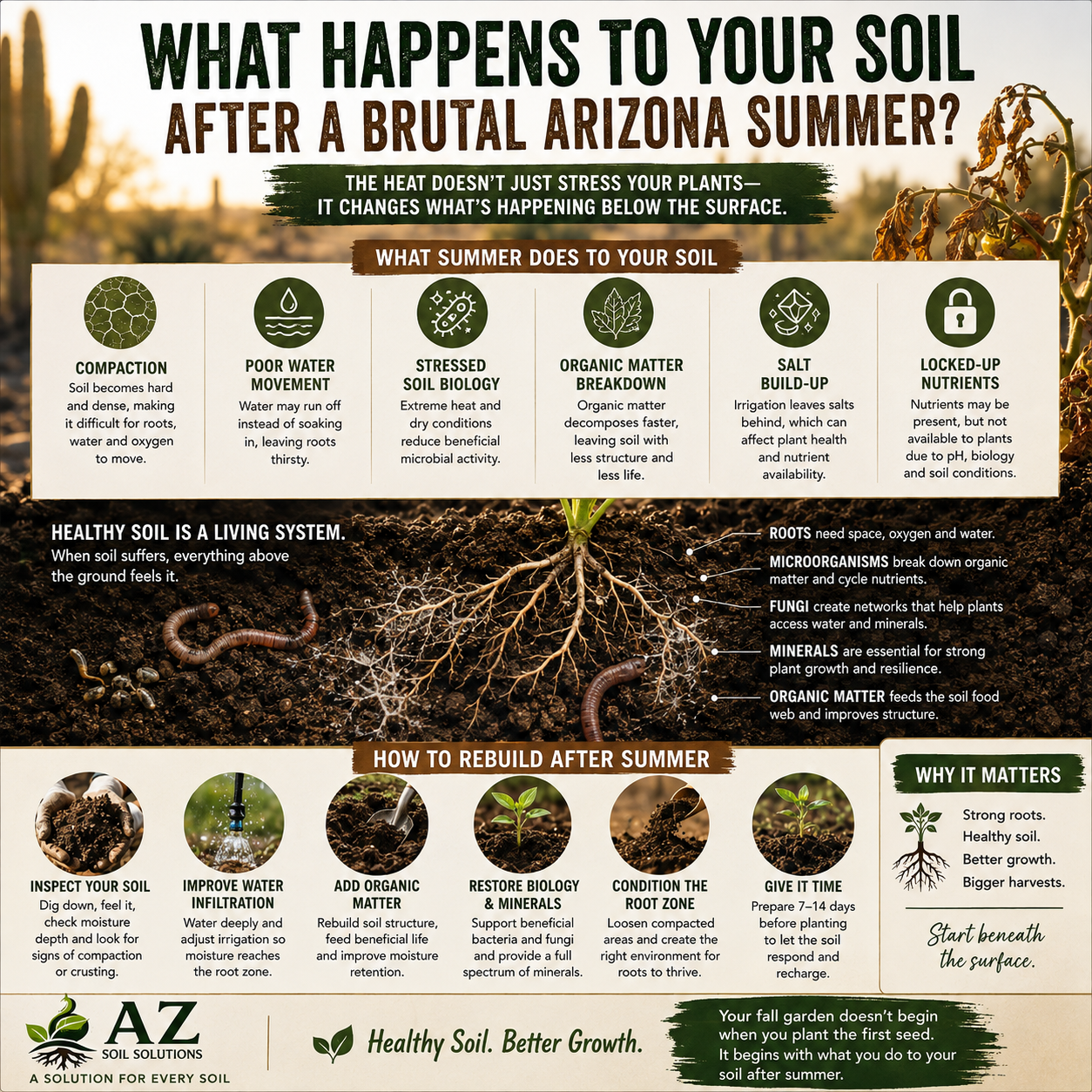
1. Your Soil Can Become Hard and Compacted
One of the most noticeable changes after summer is often the physical condition of the soil.
Repeated watering followed by intense drying can contribute to surface crusting and hard soil conditions, particularly in soils already high in clay or low in organic matter.
And compacted soil isn't just difficult to dig.
It changes the environment around the roots.
Roots need spaces within the soil where water and air can move. When soil becomes dense, those spaces can be reduced.
That can make it harder for roots to expand through the soil and can affect water infiltration and oxygen availability.
A plant might technically be surrounded by soil containing nutrients, but if its root system cannot develop effectively, accessing those resources becomes more difficult.
Healthy plants need somewhere healthy to put their roots.
2. Water May Not Be Moving the Way You Think
One of the biggest misconceptions in desert gardening is that watering the soil automatically means the root zone is being evenly hydrated.
It doesn't always work that way.
Very dry or compacted soil can sometimes absorb water unevenly. Water may run across the surface, follow cracks or preferential pathways, or wet one area while leaving another surprisingly dry.
This is why a plant can appear thirsty even when the irrigation system has been running regularly.
The important question isn't simply:
“How often am I watering?”
It is:
“Where is that water actually going?”
Before fall planting, dig several inches into your soil after watering.
Don't judge moisture by looking at the surface.
See how deeply the water penetrated and whether the soil is evenly moist through the area where your roots will actually grow.
Sometimes the solution isn't simply adding more water.
It is improving the soil's ability to receive, distribute and retain it.
3. Extreme Heat Can Stress Soil Biology
A healthy garden isn't supported by roots alone.
The soil around those roots contains an enormous biological community.
Bacteria, fungi and other microorganisms participate in the decomposition of organic materials and nutrient cycling. Plant roots and microorganisms also interact within the rhizosphere, the narrow zone of soil directly influenced by the root system. Our overview of the soil food web explains how that community works together.
These biological processes are influenced by environmental conditions, including temperature and moisture.
During prolonged periods of extreme heat and dryness, biological activity near the soil surface can change significantly.
Think of soil biology as part of an ecosystem rather than something you simply “add” once.
That ecosystem needs a suitable habitat.
It needs moisture.
It needs carbon and organic material.
It needs pore space.
It needs minerals and nutrients.
And it needs roots.
If we want beneficial organisms to help support our plants, we also need to create soil conditions capable of supporting those organisms.
4. Organic Matter Doesn't Last Forever
Compost and organic matter are extremely valuable additions to garden soil, but they are not permanent.
Organic materials continually break down.
That decomposition is actually part of what makes organic matter useful. As materials are processed, they contribute to nutrient cycling and influence soil structure, moisture retention and biological activity.
But it also means the organic matter you added last season doesn't necessarily remain unchanged forever.
Gardens are dynamic systems.
Plants grow.
Roots expand.
Organic materials decompose.
Nutrients move.
Water carries soluble materials through the soil.
And every time you harvest vegetables, prune plants or remove plant material, you're taking physical material out of that system. That is the idea behind your soil's bank account.
This is why soil building isn't a one-time project.
Healthy soil requires maintenance just like the plants growing in it.
5. Irrigation Can Leave Something Behind
Arizona gardeners don't just deal with heat.
Water quality can also influence soil over time.
Irrigation water naturally contains dissolved minerals and salts. As water evaporates or plants use it, some dissolved materials can remain behind in the soil.
In arid environments where evaporation is high, salts can accumulate, particularly when drainage is poor or there isn't enough water moving through the soil profile to carry excess salts downward.
You may sometimes notice a whitish crust on the soil surface or around containers.
That doesn't automatically mean every garden has a serious salinity problem, but it is something desert gardeners should understand and watch for. Our article on why Arizona soil is different covers pH, hard water, and caliche in more detail.
If plants repeatedly struggle despite apparently adequate water and nutrition, a soil test can provide valuable information about salinity, pH and nutrient conditions.
Guessing becomes expensive.
Testing gives you information.
6. Nutrients Can Be Present Without Being Easily Available
This is one of the most important concepts in soil health.
Having nutrients in your soil does not automatically mean your plants can access all of them efficiently.
Nutrient availability is affected by multiple factors, including soil pH, moisture, root health, biological activity and interactions between different elements.
Arizona soils are frequently alkaline, which can influence the availability of certain nutrients.
This creates an interesting situation.
A gardener may see a struggling plant and assume:
“It needs more fertilizer.”
But adding more fertilizer doesn't necessarily correct the underlying issue.
Sometimes the better question is:
What is preventing this plant from accessing what is already here?
That's a very different way of thinking about plant nutrition.
Instead of only feeding the plant, we start thinking about improving the environment surrounding the roots. That is exactly why fertilizer alone isn't enough.
Fall Soil Preparation Should Start Before Planting
When temperatures begin dropping, it's tempting to immediately start planting. Seeds are purchased. Transplants appear at garden centers. Everyone is ready for tomatoes, lettuce, carrots, herbs, broccoli and the rest of the fall garden. But give your soil some attention first. Even a week or two of preparation can give you an opportunity to evaluate and improve the environment your new plants will enter. Here's where I would start.
Step 1: Pull Back the Mulch and Look at Your Soil
Don't assume you know what's happening underneath. Dig into several areas. Is the soil loose? Hard? Powdery? Sticky? Does it smell earthy? Are roots from previous crops still present? Are earthworms or other signs of biological activity visible? How quickly does water enter the soil? This simple inspection can tell you quite a bit.
Step 2: Check Your Moisture Depth
Water the bed normally.
Then come back later and dig down.
Look at the moisture profile.
You may discover the top two inches are wet while the soil below is dry, or that one section receives substantially more water than another.
This is the perfect time to correct irrigation problems before new roots depend on that system.
Step 3: Loosen Compacted Areas Without Destroying Everything
If the soil is badly compacted, improve it before planting.
That doesn't necessarily mean aggressively tilling the entire garden.
The goal is to restore pore space and create an environment where roots, water and oxygen can move.
Work amendments into the root zone where appropriate and avoid repeatedly walking across planting beds.
Soil structure matters more than many gardeners realize.
Step 4: Replenish What the Soil System Needs
This is where soil amendments can play an important role.
Depending on your soil conditions, you may need organic matter, minerals or other amendments designed to improve the root-zone environment.
At AZ Soil Solutions, this philosophy is central to how we approach soil.
Our premium soil enhancer isn't designed around the idea that plants simply need another quick feeding.
Our focus is the soil system itself.
Our blend combines 78 naturally occurring trace minerals, montmorillonite clay, humic and fulvic acids, beneficial PGPR and PGPF biology, and wood ash. Each component has a different role within the overall soil environment. Rather than viewing soil as nothing more than something that holds a plant upright, we view it as the foundation supporting everything above it.
Step 5: Give the Soil Time
You don't necessarily need to amend the soil and plant everything five minutes later. Preparing beds ahead of planting gives you time to water amendments into the soil, observe drainage, make irrigation adjustments and correct problems before your seedlings arrive. If possible, begin evaluating and preparing your fall beds 7 to 14 days before planting. That little window can make a big difference in how prepared you are.
Don't Forget Containers and Raised Beds
This isn't only about native Arizona ground. Containers and raised beds also change over time. Potting mixes settle. Organic materials break down. Roots occupy space. Repeated irrigation moves materials through the container. Salts can accumulate.
If you've been growing in the same container for several seasons, don't assume the soil is still in the same condition as when you originally filled it.
Pull struggling plants.
Inspect the roots.
Check drainage holes.
Remove severely compacted or exhausted material where necessary.
Refresh the growing medium.
Then rebuild the root environment before planting again.
Sometimes replacing or refreshing tired soil can do far more for the next plant than simply adding another fertilizer to the old one.
Think Below the Surface
Gardening naturally draws our attention upward.
We notice the flowers.
We count tomatoes.
We watch leaves change color.
We worry when a plant wilts.
But almost every one of those things is connected in some way to what is happening underground.
Roots are searching for water.
Microorganisms are interacting with organic material and nutrients.
Water is moving, or failing to move, through pore spaces.
Minerals are present in different forms.
Organic matter is decomposing.
The soil is constantly changing.
And after months of an Arizona summer, that underground environment deserves some attention.
So before you rush outside with your fall seedlings, spend a little time with the soil they're about to call home.
Dig into it.
Feel it.
Water it.
Look at how it responds.
Ask what it needs.
Because the strongest fall garden isn't necessarily the one that receives the most fertilizer or the most water.
It's the one that begins with a strong foundation.
Healthy soil. Better growth.
And remember:
Your fall garden doesn't begin when you plant the first seed. It begins with what you do to your soil after summer.
AZ Soil Solutions
A Solution for Every Soil
Rebuilding your beds after summer? Tell us about your soil and we'll recommend an application plan.